2026-08-28 国立精神・神経医療研究センター
<関連情報>
- https://www.ncnp.go.jp/topics/detail.php?@uid=gvMFGePM1imVAjPp
- https://www.cell.com/iscience/fulltext/S2589-0042(26)02713-6
L1レトロトランスポジションとDNA修復欠損の同時発生は、S期成熟ニューロンにおいて合成致死を引き起こす Coincidence of L1 retrotransposition and DNA repair deficiency elicits synthetic lethality in S-phase mature neurons
Fumio Takahashi ∙ Takashi Yamamura ∙ Shinji Oki
iScience Published:August 24, 2026
DOI:https://doi.org/10.1016/j.isci.2026.117335
Highlights
- Aberrant cell cycle re-entry (CCR) is widely observed in mature neurons
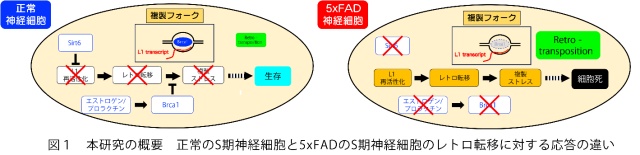
- The replication fork is the target site for L1 retrotransposition (L1-LTP) in S-phase neurons
- The DNA repair machinery is impaired in S-phase neurons in the process of neurodegeneration
- L1-LTP under DNA repair deficiency promotes synthetic lethality in S-phase neurons
Summary
Neurodegeneration involves the entangled processes of cell-autonomous and non-cell-autonomous neuronal cell death, which leads to a collapse in the integrity of the neural network and causes behavioral symptoms. Here, we demonstrate that aberrant cell cycle re-entry (CCR) is prominent in mature neurons and that the replication fork acts as a target site for long interspersed nuclear element-1 (L1) retrotransposition during neurodegeneration. The fatal susceptibility of S-phase neurons in 5xFAD mice is attributed to a DNA repair deficiency in response to L1-mediated replication stress. Impaired sirtuin 6 expression seems to allow stochastic L1 activation and enhanced retrotransposition. Reduced estrogen/prolactin signaling correlates well with reduced Brca1 expression that is thought to protect neurons from replication stress. Importantly, L1-mediated pathogenesis correlates well with conventional Alzheimer’s disease pathology. In summary, the combination of enhanced L1 retrotransposition and DNA repair deficiency elicited synthetic lethality in S-phase neurons, highlighting a previously unknown pathogenic mechanism of neurodegeneration.