2026-09-17 広島大学
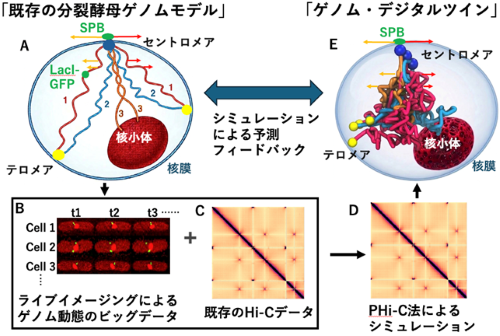
図 分裂酵母染色体の大規模動態測定とモデリング(PHi-C)を組み合わせた「デジタルツイン」の構築
<関連情報>
分裂酵母におけるゲノム構造と動態の統合的モデリング Integrative modeling of the genome structure and dynamics in fission yeast
Soya Shinkai, Toshinori Namba, Takeshi Sugawara, +6 , and Shin-ichi Tate
Proceedings of the National Academy of Sciences Published:September 8, 2026
DOI:https://doi.org/10.1073/pnas.2612002123
Abstract
Genome organization in the nucleus is highly structured and dynamic. Recent advances in genomic technology have enabled the measurement of genome-wide architecture and locus-specific motion, yielding contact maps and live-cell trajectories. However, these outcomes are derived from different modalities and are not directly comparable, with their quantitative integration being a key challenge. Here we establish a genome-wide live-cell imaging platform in fission yeast Schizosaccharomyces pombe, tracking 131 chromosomal loci, along with the spindle pole body (SPB) and nucleolus, to construct a quantitative map of locus dynamics. By integrating these dynamics with contact data through polymer modeling of Hi-C data, we build a physics-based “digital twin” of the S. pombe genome consistent with the spatiotemporal dynamics of interphase chromatin. We validate it against genome-wide mobility patterns and known architectural features, including centromere and telomere clustering. The model also identifies distinct dynamical regimes: centromere- and telomere-proximal loci relax within ∼150 s, whereas the remaining loci relax within ∼70 s. We measure semiperiodic dynamics of SPB motion, including a characteristic peak near 225 s and 1/f fluctuations. We use the model with SPB-directed forcing to show how these low-frequency components propagate through the genome to drive genome-wide chromatin displacements. Together, this predictive physics-based modeling framework integrates genome structure and dynamics to reveal how nuclear mechanical driving forces shape chromosome motion, linking mechanically driven chromatin responses to genome maintenance and regulation.