2026-09-18 インペリアル・カレッジ・ロンドン(ICL)
<関連情報>
- https://www.imperial.ac.uk/news/articles/2026/-chronic-stress-may-trigger-hidden-inflammation-that-damages-the-heart/
- https://academic.oup.com/eurjpc/advance-article/doi/10.1093/eurjpc/zwag435/8802224
遺伝子と環境の相互作用がサイトカインを介した炎症と心血管リスクを形成する Gene–environment interactions shape cytokine-mediated inflammation and cardiovascular risk
Mattia Corianò, Shamin Tahasildar, Ling Huang, Khaled Rjoob, Majid Vafaeezadeh, Soodeh Kalaie, Jin Zheng, Lara Curran, Parisa Gifani, Marc-Emmanuel Dumas,…
European Journal of Preventive CardiologyPublished:18 September 2026
DOI:https://doi.org/10.1093/eurjpc/zwag435
Abstract
Background
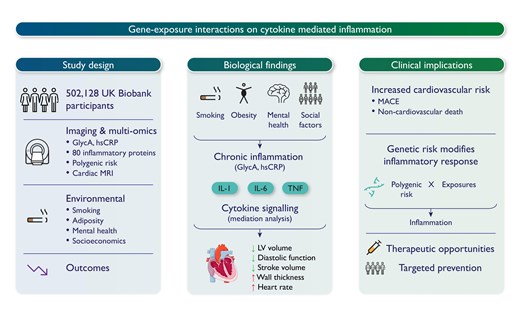
Chronic inflammation is a major driver of cardiovascular diseases, but mechanisms linking systemic inflammation to cardiac remodelling remain incompletely understood. We aimed to evaluate the role of cytokine-mediated signalling and the influence of environmental and genetic factors on inflammation and cardiac phenotypes in a large population-based cohort.
Methods
We analysed subsets of 488 079 UK Biobank participants with metabolomic and proteomic profiling, cardiac magnetic resonance (CMR) imaging, and longitudinal outcomes. Chronic inflammation was quantified using glycoprotein acetyls (GlycA) by nuclear magnetic resonance spectroscopy. Machine learning-based analysis extracted CMR phenotypes. Multivariable linear regression assessed GlycA-cardiac associations. Mediation analysis tested 80 inflammatory proteins as potential mediators. Cox models evaluated GlycA levels and major adverse cardiovascular events (MACEs). An exposome-wide association study identified environmental determinants of inflammation, and gene–environment interactions were assessed using multi-ancestry polygenic risk scores.
Results
Higher GlycA levels were associated with reduced left ventricular indexed end-diastolic volume (β=-2.09) and stroke volume (β=-1.12), with compensatory increased heart rate (β=1.38; all P<10-228). Interleukin (IL)-1 receptor antagonist statistically mediated 27% of the GlycA effect on end-diastolic volume (average causal mediated effect -0.53 [95% CI, -0.64 to -0.41]; P<10-16). The highest GlycA quintile had 43% higher MACE risk versus the lowest (adjusted HR, 1.43 [95% CI, 1.38–1.49]). Trunk fat mass (β=0.35), current smoking (β=0.39), psychological distress, and low socioeconomic status were the strongest GlycA determinants (all P<10-50). Cardiovascular polygenic risk scores modified associations between environmental exposures, inflammation, and MACE.
Conclusions
Chronic systemic inflammation is associated with reduced left ventricular volumes and increased cardiovascular risk in the community, with circulating cytokines and growth factors including IL-1 and TNF identified as potential mediators of these associations. Exposure-gene interactions are associated with inflammatory responses such that risk may reflect the convergence of inherited and acquired factors.