2026-09-24 カロリンスカ研究所(KI)
<関連情報>
- https://news.ki.se/new-study-reveals-differences-in-gestational-diabetes-between-social-groups
- https://academic.oup.com/jcem/advance-article/doi/10.1210/clinem/dgag366/8786415
妊娠糖尿病の有病率と合併症負担における社会的不平等:スウェーデン全国コホート研究 Social inequalities in gestational diabetes prevalence and complication burden: a nationwide Swedish cohort study
Nina Kaegi-Braun, Emmie Söderström Shields, Matilda Ersson, Rickard Strandberg, Vasileios Papapanagiotou, Caroline Lilliecreutz, Marie Löf
The Journal of Clinical Endocrinology & Metabolism Published:07 September 2026
DOI:https://doi.org/10.1210/clinem/dgag366
Abstract
Context
While studies from other settings have shown associations between social determinants of health (SDOH) and GDM, evidence remains limited in high-income, equity-oriented health-care settings.
Objective
This work aimed to examine the association between SDOH, GDM, and GDM-related complications in Sweden.
Methods
This retrospective cohort study used nationwide registry data linked across multiple population-based registries. Participants included 938 798 singleton pregnancies. Exposures included GDM, with effect modification by region of birth, education, and income. Main outcomes included number of pregnancy, obstetric, postpartum, and neonatal complications.
Results
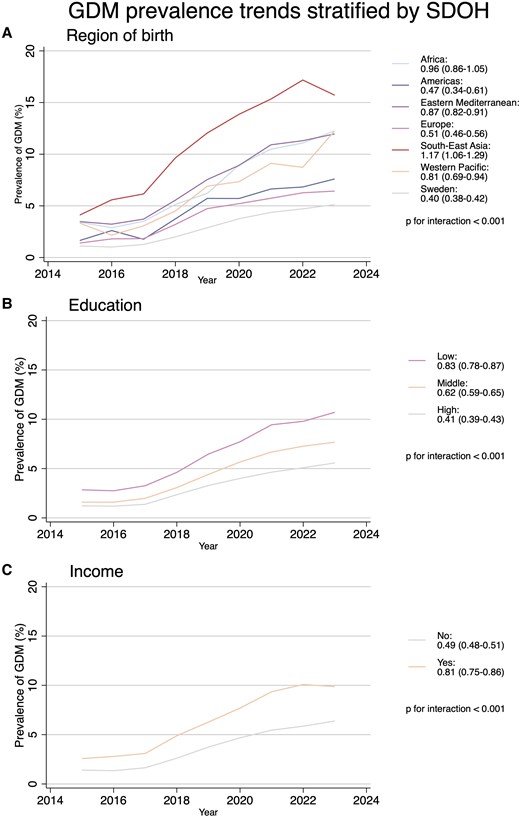
The prevalence of GDM increased from 1.5% to 6.6% between 2015 and 2023, with the steepest increases observed among individuals of foreign-born origin, lower education, and lower income. While income did not show evidence of interaction with GDM regarding the number of complications, the associations between GDM and both pregnancy-related and obstetric complications varied across educational attainment groups, with larger relative associations observed among women with lower education (Pinteraction = .029 and .038, respectively).
The associations between GDM and several adverse outcomes differed by nativity status. For example, GDM was associated with 71% higher odds of obstetric complications among Swedish-born women (odds ratio [OR], 1.71; 95% CI, 1.68-1.85), whereas the corresponding associations were significantly weaker among women born in Africa (1.34; 1.17-1.52) and the Eastern Mediterranean region (1.44; 1.34-1.56).
However, absolute risks were not uniformly lower among foreign-born women with GDM. Notably, women born in Africa and South-East Asia had higher absolute risks of obstetric complications compared with Swedish-born without GDM.
Conclusion
Disparities in GDM prevalence across all 3 SDOH indicators underscore the importance of considering sociodemographic factors in prevention efforts. Variation in GDM-associated risks by educational level and region of birth warrant further investigation to ensure equitable care.