2026-09-24 スイス連邦工科大学ローザンヌ校(EPFL)
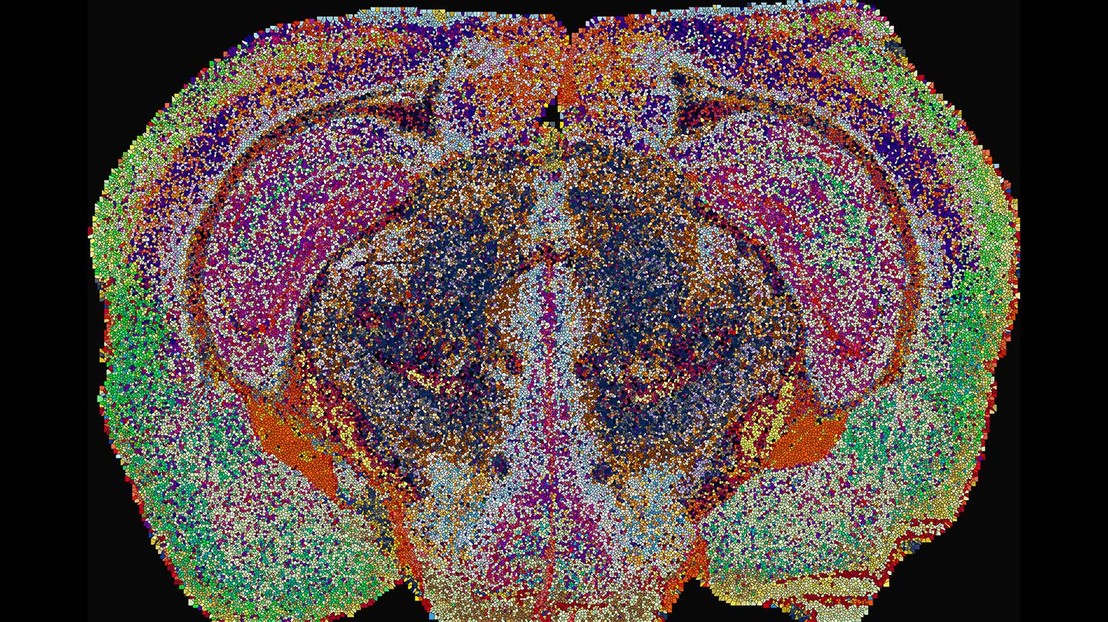
Lipizones in the mouse brain, determined by MALDI-MSI. Dots are enlarged for visualization purposes. Credit: 2026 EPFL/Luca Fusar Bassini – CC-BY-SA 4.0
<関連情報>
- https://actu.epfl.ch/news/the-first-map-of-lipids-in-the-mouse-brain/
- https://www.nature.com/articles/s41586-026-11050-0
マウス脳の脂質組成構造 The lipidomic architecture of the mouse brain
Luca Fusar Bassini, Halima Hannah Schede, Laura Capolupo, Leila Haj Abdullah Alieh, Irmak Kaysudu, Francesca Venturi, Hannah Hochgerner, Alessandro Valente, Colas Droin, Daniel Trejo Banos, Irina Khven, Jean Andrea Maillat, Anne-Laure Mahul-Mellier, Antonino Asaro, Doğukan H. Ülgen, Pavel Barahtjan, Ece Z. Asirim, Anita Nasrallah, Carmen Sandi, Ekaterina Krymova, Giovanni D’Angelo & Gioele La Manno
Nature Published:23 September 2026
DOI:https://doi.org/10.1038/s41586-026-11050-0
Abstract
Lipids are fundamental components of the brain, crucial for synaptic transmission and signal propagation. Altered brain lipid composition is associated with common and rare neuropathologies, yet the spatial organization of the mammalian brain lipidome remains insufficiently characterized compared with other modalities1,2,3,4,5,6. Here we mapped the membrane-lipid architecture of the adult mouse brain at micrometric scale, across sexes and during pregnancy. This lipid brain atlas reveals that lipids describe a fine-grained biochemical structure that aligns with functional anatomy. Membrane-lipid spatial heterogeneity clusters into territories, which we termed ‘lipizones’. Lipizones partially mirror cell-type territories, but also capture distal axon terminals. Through lipizones, we (1) reveal the organizing principles of the grey matter lipidome, related to connectivity and cytoarchitecture; (2) discover a new axis of oligodendrocyte heterogeneity in the white matter; and (3) find biochemical zonation in the choroid plexus and in the ventricular walls. We show that this lipidomic architecture can adapt to changing physiological needs. In the brain of pregnant female mice, the white matter is metabolically activated and the cortex undergoes a lipizone-specific remodelling that is particularly pronounced in layer 4. These results are a foundational resource (https://lbae-v2.epfl.ch/) poised to reshape the understanding of lipids in brain development, physiology and pathology.