2026-09-28 京都大学
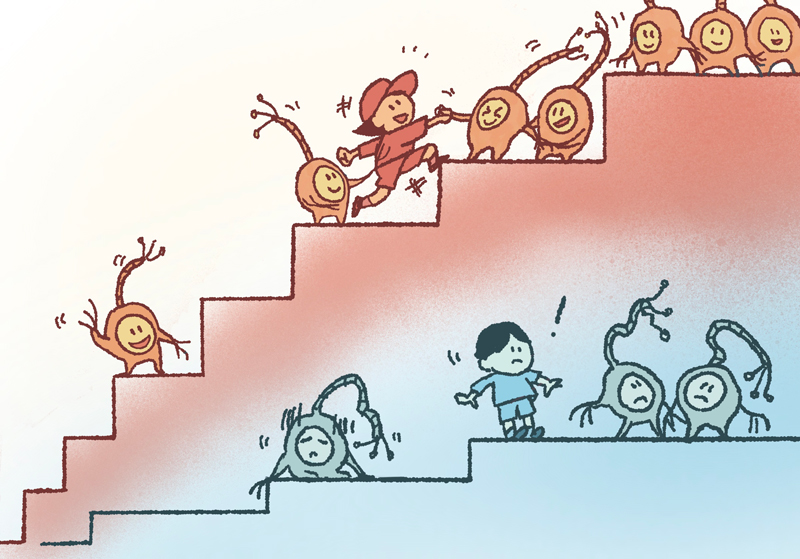
神経細胞の数を増やしたときに読み取れる情報量の増え方を表したイメージ図(Illust. Robin Hoshino)
<関連情報>
- https://www.kyoto-u.ac.jp/ja/research-news/2026-09-28
- https://www.science.org/doi/10.1126/sciadv.adz9632
⾼次元ノイズのスケール不変性のもとにおける集団符号化 Population coding under the scale invariance of high-dimensional noise
S. Amin Moosavi, Sai Sumedh R. Hindupur, and Hideaki Shimazaki
Science Advances Published:25 Sep 2026
DOI:https://doi.org/10.1126/sciadv.adz9632
Abstract
High-dimensional scale-invariant neural activity is ubiquitous across brain regions and species, but its implications for information coding remain unclear. Here, we ask how stimulus information in the high-dimensional activity of mouse V1 scales with neuron number: Does it saturate due to noise correlations or increase without bound as subpopulations grow? Contrary to previous reports, we find that leading noise components that scale linearly with population size, and thus can limit information, are not sufficiently aligned with the signal to impose a bound. This conclusion follows from two scale-invariant power-law properties of neuronal responses in mouse V1: the noise eigenspectrum and alignment of noise components with the signal. We show that population subsampling links the observed power-law exponents to information boundedness and that information scaling depends on the full eigenspectrum rather than its leading modes. Last, we prove that, under subsampling, information-limiting correlations, if present, are differential correlations. Our findings clarify how information scales in high-dimensional neuronal activity under scale-invariant noise.