2026-10-01 国立がん研究センター
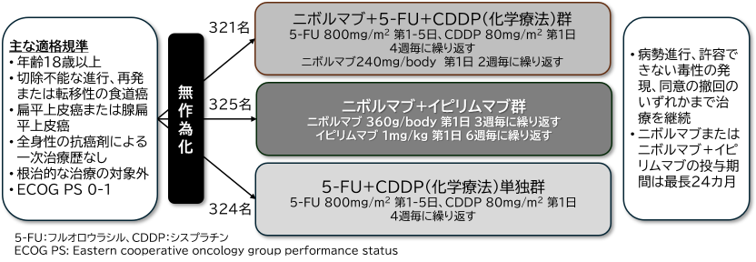
図1 CheckMate 648試験デザイン
<関連情報>
- https://www.ncc.go.jp/jp/information/researchtopics/2026/1001/index.html
- https://www.annalsofoncology.org/article/S0923-7534(26)01455-9/fulltext
進行性食道扁平上皮癌の一次治療として、ニボルマブ+化学療法またはイピリムマブと化学療法単独を比較したCheckMate 648試験の5年間の追跡調査結果 Nivolumab plus chemotherapy or ipilimumab versus chemotherapy as first-line treatment for advanced esophageal squamous cell carcinoma: 5-year follow-up results from CheckMate 648
K. Kato ∙ J. Ajani ∙ Y. Doki ∙ … ∙ Y. Matsumura ∙ Y. Kitagawa ∙ I. Chau
Annals of Oncology Published:August 10, 2026
DOI:https://doi.org/10.1016/j.annonc.2026.08.001
Highlights
- At 5 years of follow-up, NIVO plus chemotherapy (chemo) or IPI continued to provide OS benefit versus chemo.
- OS benefit was observed with both NIVO-based regimens in patients with tumor cell PD-L1 ≥1% and all randomized patients.
- OS at 5 years in patients with PD-L1 ≥1% was 12% with NIVO + chemo, 18% with NIVO + IPI, and 7% with chemo.
- ORR was higher with NIVO + chemo regardless of PD-L1 status and was higher with NIVO + IPI in patients with PD-L1 ≥1%.
- The safety profiles of each treatment regimen were consistent with previous reports with no new safety signals.
Abstract
Background
Both nivolumab plus chemotherapy (P < 0.001) and nivolumab plus ipilimumab (P = 0.001) demonstrated significant overall survival (OS) benefit compared with chemotherapy for patients with previously untreated advanced esophageal squamous-cell carcinoma (ESCC) and programmed death-ligand 1 (PD-L1) ≥1%. We report OS and additional analyses at a minimum follow-up of 5 years.
Patients and methods
The open-label, phase III CheckMate 648 trial (NCT03143153) enrolled patients with previously untreated, unresectable, advanced, recurrent, or metastatic ESCC. Patients were randomly assigned 1:1:1 to nivolumab plus chemotherapy, nivolumab plus ipilimumab, or chemotherapy. The primary endpoints were OS and progression-free survival (PFS) by blinded independent central review (BICR) in patients with tumor cell PD-L1 expression ≥1%. Key secondary endpoints included OS and PFS by BICR in all randomly assigned patients.
Results
In total, 970 patients were randomly assigned. At the 5-year minimum follow-up, OS improvement continued to be observed with nivolumab plus chemotherapy versus chemotherapy [hazard ratio (HR) 0.62, 95% confidence interval (CI) 0.48-0.79] and nivolumab plus ipilimumab versus chemotherapy (HR 0.62, 95% CI 0.48-0.80) in patients with tumor cell PD-L1 ≥1%. OS benefit was also observed in all randomly assigned patients (HR 0.77, 95% CI 0.65-0.92 for both nivolumab plus chemotherapy and nivolumab plus ipilimumab versus chemotherapy). PFS benefit was observed with nivolumab plus chemotherapy versus chemotherapy in the tumor cell PD-L1 ≥1% (HR 0.67, 95% CI 0.51-0.88) population but not with nivolumab plus ipilimumab versus chemotherapy (HR 1.03, 95% CI 0.78-1.35). Among all treated patients, grade 3-4 treatment-related adverse events were observed in 49% of patients in the nivolumab plus chemotherapy group, 33% in the nivolumab plus ipilimumab group, and 37% in the chemotherapy group.
Conclusions
Nivolumab-containing treatment regimens continued to demonstrate clinically meaningful OS benefit versus chemotherapy at the 5-year follow-up, with no new safety signals. These data further support nivolumab in combination with chemotherapy or ipilimumab as first-line treatment for patients with advanced ESCC.