2026-10-14 東北大学
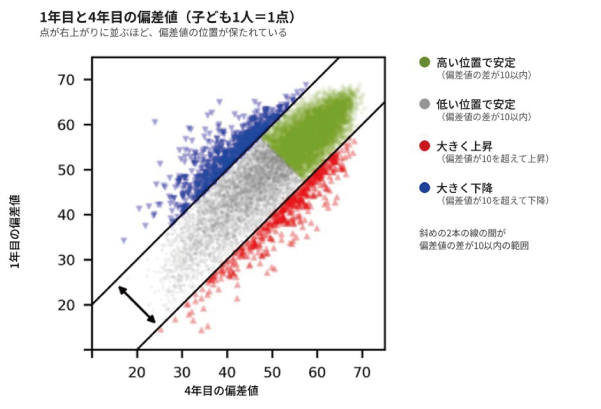
図1. 1年目と4年目の偏差値の関係(宮城県内の自治体、子ども1人が1点)。点が右上がりに並ぶほど、偏差値の位置が保たれていることを示します。斜めの2本の線の外側(赤・青)が、偏差値が10を超えて上昇・下降した子どもです。
<関連情報>
- https://www.tohoku.ac.jp/japanese/2026/10/press20261014-04-adolescence.html
- https://www.nature.com/articles/s41598-026-72860-w
思春期初期における学業成績の変化は、ベースラインのプロファイルではなく、同時進行する行動の変化によって特徴づけられる Shifting academic fates in early adolescence are marked by concurrent behavioural change rather than baseline profiles
Chihiro Hosoda, Kenchi Hosokawa, Takuto Matsuhashi, Nanase Takahashi, Yu Hayashizaki, Yutaka Matsuzaki & Ryuta Kawashima
Scientific Reports Published:28 September 2026
DOI:https://doi.org/10.1038/s41598-026-72860-w Early provide
Abstract
Academic performance in childhood is highly stable in relative rank, yet the behavioural characteristics that accompany stable versus changing achievement standing remain unclear. We longitudinally tracked 16,946 students (grades 4–9; approximate grade-derived baseline ages 11.9 and 11.4 years) over 3–4 years in two contrasting Japanese cities, using achievement tests standardized annually within city and grade, and lifestyle–learning questionnaires. All trajectories therefore describe changes in students’ relative standing, not absolute learning growth. Most students’ relative standing was stable and classified well from baseline questionnaire responses, a distinction that largely reflects baseline achievement level, with stable high standing accompanied by consistent daily routines, family support, and active classroom engagement. Approximately 9% of students rose or fell substantially; these shifts were weakly classified from Year 1 behavioural profiles but were marked by concurrent changes in study investment, motivation-related responses, and digital-media use. Behavioural information available through Year 3 added minimal prospective information about Year 4 standing beyond prior achievement (ΔR² = 0.002), indicating that these changes accompany, rather than forecast, shifts in relative standing. Stable and changing academic standing were thus marked by distinct behavioural profiles—observable markers whose causal status and modifiability warrant prospective and experimental study.