(Chemical recycling makes useful product from waste bioplastic)
2020/5/21 英国・バーミンガム・シティ大学
・ バーミンガム・シティ大学とバース大学が、植物ベースのバイオプラスチックをより効率的に化学的にリサイクルする技術を開発。
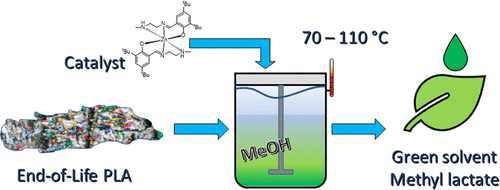
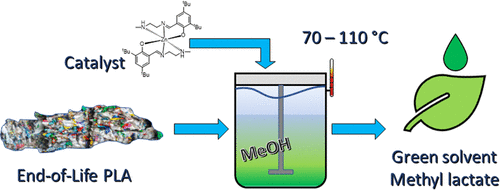
・ 同化学リサイクル技術は、亜鉛ベースの触媒とメタノールを使用し、プロセスのスピードアップに加え、廃棄バイオプラスチックを化粧品や薬品会社等の産業で使用できる生分解性溶剤の乳酸メチルに迅速に転換する。
・ ポリ乳酸(PLA)製のバイオプラスチックは、使い捨てカップ、パッケージングや玩具等で広く利用されている。それらの製品寿命の終了後は、埋立地に廃棄されるか、コンポスト処理で数か月をかけて生物分解される。
・ 使い捨てカップ、3D プリント廃棄物および玩具の 3 種類の PLA 製品で同化学リサイクル技術の試験を実施。カップが最も容易に低温度下で、玩具に含まれるより大きなプラスチックは高温度下で、それぞれ乳酸メチルに転換できた。
・ 各製品の着色剤、添加剤やサイズ、分子量にかかわらず、高品質の生分解性溶剤への転換が可能。同新技術では、バイオプラスチックを化学構成要素に分解してから新しい製品に「再構築」するため、他の製品やプロセスに利用可能な高品質を確保できる。
・ 乳酸メチルの収量は現時点では最高 300ml であるため、次の段階では、産業規模での使用に向けてリアクタをスケールアップする。
・ 本研究には、英国工学・物理科学研究評議会(EPSRC)が資金を提供した。
URL: https://www.birmingham.ac.uk/news/latest/2020/05/chemical-recycling-makes-usefulproduct-from-waste-bioplastic.aspx
<NEDO海外技術情報より>
(関連情報)
Industrial & Engineering Chemistry Research 掲載論文(フルテキスト)
Chemical Degradation of End-of-Life Poly(lactic acid) into Methyl Lactate by a Zn(II) Complex
URL: https://pubs.acs.org/doi/10.1021/acs.iecr.0c01122
Abstract
The catalyzed methanolysis of end-of-life poly(lactic acid) (PLA) products by an ethylenediamine Zn(II) complex to form biodegradable methyl lactate was studied experimentally at 70, 90, and 110 °C. The PLA samples consisted of typical consumer waste materials, including a cup, a toy, and a three-dimensional (3D) printing material. High selectivities and yields (>94%) were possible depending on temperature and reaction time. Additionally, and to develop a predictive kinetic model, kinetic parameters (pre-exponential factor and activation energies) of the PLA transesterification reaction were first obtained from virgin PLA. These parameters were subsequently used to estimate the conversion of PLA, selectivity, and yield of methyl lactate after 1 and 4 h of the reaction, and the results were compared with the experimental values of the end-of-life PLA. Despite the presence of unknown additives in the PLA waste material and uncontrolled particle size, the model was able to predict the overall conversion, selectivity, and yield to an average deviation of 5, 7, and 12%, respectively. A greater agreement between the model and experimental values is observed for the higher temperatures and the longer reaction time. Larger deviations were observed for the PLA toy, which we attribute to the presence of additives, since despite its lower molecular weight, it possessed a higher structural strength.