2025-06-24 東京大学
<関連情報>
- https://www.s.u-tokyo.ac.jp/ja/press/10839/
- https://www.jneurosci.org/content/early/2025/06/02/JNEUROSCI.2365-24.2025
マウスのREM睡眠調節における多面的役割を示唆する背側橋におけるCrhbp陽性ニューロンの多様な発火プロファイル Diverse firing profiles of Crhbp-positive neurons in the dorsal pons suggestive of their pleiotropic roles in REM sleep regulation in mice
Yoshifumi Arai, Mitsuaki Kashiwagi, Takeshi Kanda, Iyo Koyanagi, Masanori Sakaguchi, Masashi Yanagisawa, Yoshimasa Koyama and Yu Hayashi
Journal of Neuroscience Published:23 June 2025
DOI:https://doi.org/10.1523/JNEUROSCI.2365-24.2025
Abstract
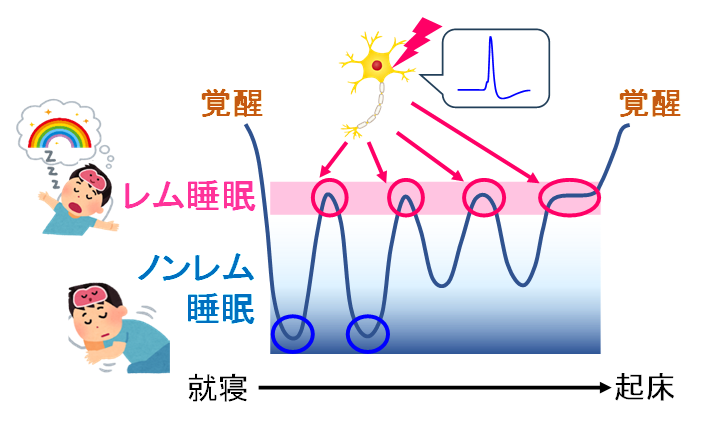
Rapid eye movement (REM) sleep is primarily regulated by the brainstem pons. In particular, the sublaterodorsal tegmentum (SubLDT) in the dorsal pons contains neurons whose activity is selective to REM sleep. Elucidation of the precise identities of these neurons and their roles in REM sleep regulation is challenging, however, due to the functional and molecular heterogeneity of the SubLDT. A recent study revealed that corticotropin-releasing hormone-binding protein (Crhbp)-positive neurons in the SubLDT projecting to the medulla play a crucial role in REM sleep regulation and that loss of these Crhbp-positive neurons underlies sleep deficits observed in Parkinson’s disease. The firing patterns of these neurons during sleep/wake, however, remained unknown. Here, we used an opto-tagging method and conducted cell-type-specific recordings from Crhbp-positive neurons using a glass pipette microelectrode in unanesthetized male mice. We recorded 58 Crhbp-positive neurons and found that many of these neurons are REM sleep-active neurons (41.4%) and that the remaining neurons are mostly either wake-active, wake/REM sleep-active, or NREM sleep-active. In addition, projection-specific recordings revealed that the medulla-projecting Crhbp-positive neurons are mostly REM sleep-active neurons (75.0%). Based on clustering analysis and spike waveform analysis, REM sleep-active Crhbp-positive neurons can be further divided into different subtypes according to their electrophysiological properties, suggesting that Crhbp-positive neurons play diverse roles in REM sleep regulation.
Significance statement Reduced REM sleep is a risk for dementia and mortality, suggesting it has critical roles in health. The mechanisms and functions of REM sleep, however, remain largely elusive. Classical electrophysiological studies identified neurons in the pons that are active during REM sleep, and a recent study revealed that Crhbp-positive neurons within the same area contribute to REM sleep regulation. The relationship between the neurons identified in each study, however, remained unknown. Loss of Crhbp-positive neurons underlies sleep deficits in Parkinson’s disease, underscoring the importance of characterizing these neurons. Our study revealed that many of the Crhbp-positive neurons are REM sleep-active and comprise distinct subtypes in regard to firing patterns, suggesting their diverse roles in REM sleep regulation.