2025-08-08 国立精神・神経医療研究センター,東京都医学総合研究所
<関連情報>
- https://www.ncnp.go.jp/topics/detail.php?@uid=W3tP0uEjpd86j96E
- https://www.nature.com/articles/s44271-025-00296-5
問題のあるオンラインゲームは、思春期の注意欠如・多動症とその後続する精神健康問題との関連を仲介する Problematic online gaming mediates the association between attention-deficit/hyperactivity and subsequent mental health issues in adolescents
Zui C. Narita,Jordan DeVylder,Gemma Knowles,Shuntaro Ando,Syudo Yamasaki,Mitsuhiro Miyashita,Daniel Stanyon,Satoshi Yamaguchi,Toshiaki A. Furukawa,Kiyoto Kasai & Atsushi Nishida
Nature Psychology Published:04 August 2025
DOI:https://doi.org/10.1038/s44271-025-00296-5
Abstract
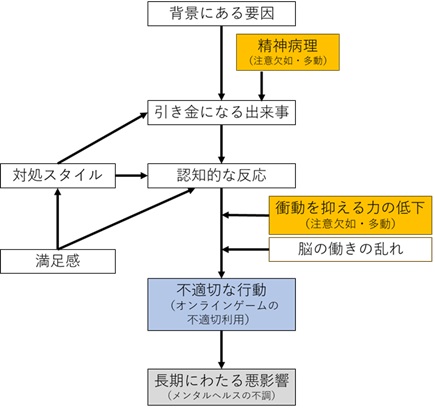
Theoretical models suggest that attention-deficit/hyperactivity and problematic online gaming could contribute to negative mental health outcomes, yet evidence on their interplay remains limited. Using data from 3171 adolescents in the Tokyo Teen Cohort, the present study examined the interplay of attention-deficit/hyperactivity at age 12 and problematic online gaming at age 14 associated with mental health issues at age 16. The sample consisted of 1487 girls (46.9%) and 1684 boys (53.1%). Doubly robust estimation revealed that a high degree of problematic online gaming consistently elevated the absolute and relative risks of mental health issues. The fully adjusted risk difference and risk ratio (95% confidence intervals (CIs)) were: incident depression, 7.8% (3.0%–13.1%) and 1.62 (1.25–2.05); incident anxiety, 5.7% (2.7%–8.7%) and 1.98 (1.45–2.67); incident psychotic experiences, 5.9% (2.3%–10.8%) and 1.72 (1.30–2.47); diminished well-being, 9.6% (5.1%–14.3%) and 1.54 (1.27–1.84). Higher attention-deficit/hyperactivity scores were associated with a greater degree of problematic online gaming (adjusted β per 1 SD: 0.18, 95% CI: 0.12–0.24). Causal mediation analysis—ensuring temporal plausibility, carefully adjusting for confounders, and accounting for exposure–mediator interaction—showed that problematic online gaming partially mediated the association between attention-deficit/hyperactivity and mental health issues: depressive symptoms (29.2%), anxiety (12.3%), psychotic experiences (20.6%), and diminished well-being (22.1%). The findings highlight the interplay of psychopathology, diminished inhibitory control, and addictive behaviors associated with negative consequences. Problematic online gaming may represent a modifiable mediator, warranting further intervention research to examine its potential as a treatment target.