2025-10-13 カリフォルニア工科大学(Caltech)
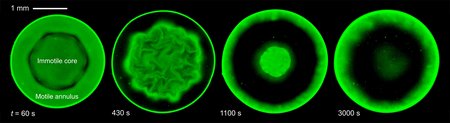
Microscopy images showing the time evolution of a drop of bacteria (cells shown in green) suspended in a polymeric fluid akin to mucus. Initially, a dense immotile core forms, surrounded by a motile annulus. However, eventually, the swimming cells in the annulus generate coherent swirls that mix the core. More cells also localize at the air–liquid interface, causing the core to shrink over time.Credit: Hakmabad et al./PNAS
<関連情報>
- https://www.caltech.edu/about/news/a-breath-of-fresh-air-bacteria-confined-to-droplets-form-complex-patterns
- https://www.pnas.org/doi/10.1073/pnas.2503983122
閉じ込められた細菌懸濁液の空間的自己組織化 Spatial self-organization of confined bacterial suspensions
Babak Vajdi Hokmabad, Alejandro Martínez-Calvo, Sebastian Gonzalez La Corte, and Sujit S. Datta
Proceedings of the National Academy of Sciences Published:October 6, 2025
DOI:https://doi.org/10.1073/pnas.2503983122
Significance
Bacteria often live in confined spaces (e.g., biological tissues, soil pores) where essential resources like oxygen are scarce. The population-scale implications of such confinement-induced chemical heterogeneities are poorly understood. Here, we show that when motile bacteria are confined to small droplets, they spontaneously organize in space—forming a concentrated immotile core surrounded by a shell of motile cells. This self-organization emerges from a feedback loop: cells consume oxygen, creating gradients that alter cellular motility and distribution, which in turn reshapes these gradients. We establish a biophysical model that quantitatively describes how this phenomenon depends on system parameters. Our findings could help understand bacterial ecological niches and inform approaches to engineer artificial active matter systems that self-organize through chemical feedback loops.
Abstract
Lab studies of bacteria usually focus on cells in spatially extended, nutrient-replete settings, such as in liquid cultures and on agar surfaces. By contrast, many biological and environmental settings—ranging from mucus in the body to ocean sediments and the soil beneath our feet—feature multicellular bacterial populations that are confined to tight spots where essential metabolic substrates (e.g., oxygen) are scarce. What influence does such confinement have on a bacterial population? Here, we address this question by studying suspensions of motile Escherichia coli confined to quasi two-dimensional (2D) droplets. We find that when the droplet size and cell concentration are both large enough, the initially uniform suspension spatially self-organizes into a concentrated, immotile inner “core” that coexists with a more dilute, highly motile surrounding “shell.” By simultaneously measuring cell concentration, oxygen concentration, and motility-generated fluid flow, we show that this behavior arises from the interplay between oxygen transport through the droplet from its boundary, uptake by the cells, and corresponding changes in their motility in response to oxygen variations. Furthermore, we use biophysical theory and simulations to quantitatively describe this interplay. Our work thus sheds light on the rich collective behaviors that emerge for bacterial populations in confined environments, with implications for understanding ecological niches and engineering artificial systems.