2026-05-20 中国科学院(CAS)
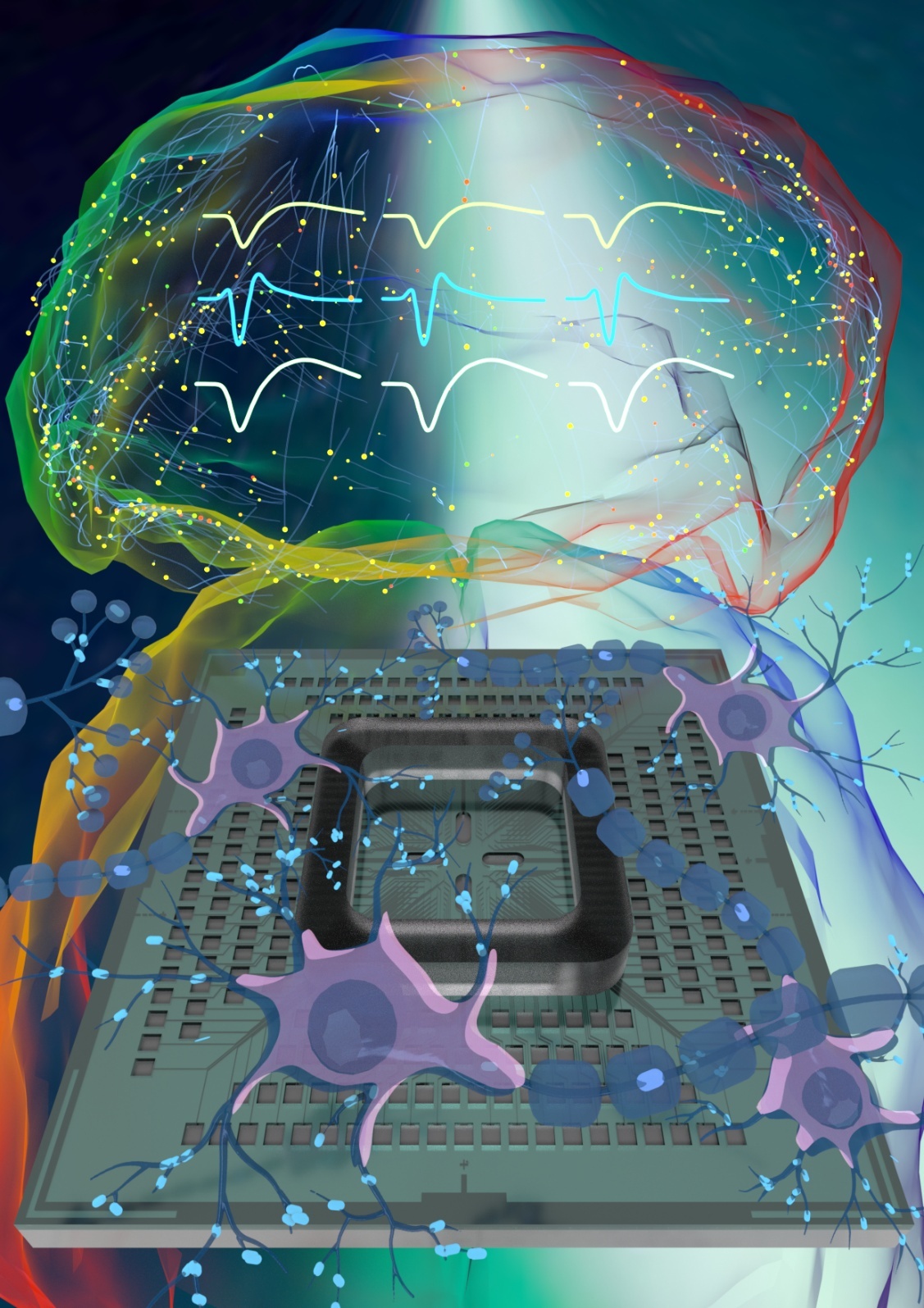
From living neurons to intelligent chips: a brain-on-chip platform enabling low-power, high-speed neural computing. (Image by AIRCAS)
<関連情報>
- https://english.cas.cn/newsroom/research-news/202605/t20260520_1159674.shtml
- https://pubs.acs.org/doi/10.1021/acssensors.5c03461
試験管内生物学的神経ネットワークは、予測可能な刺激によって低消費電力と高速通信を実現する In Vitro Biological Neuronal Networks Achieve Low-Power Consumption and High-Speed Communication through Predictable Stimulation
Longhui Jiang,Yanbing Wang,Jinping Luo,Yaoyao Liu,Kui Zhang,Xinyi Wang,Yu Wang,Yu Liu,Shutong Sun,Li Shang,Chengji Lu,Longze Sha,Mixia Wang,Qi Xu,and Xinxia Cai
ACS Sensers Published: April 15, 2026
DOI:https://doi.org/10.1021/acssensors.5c03461
Abstract
Biological neural networks (BNNs) promise low-power consumption and massive parallelism, offering a plausible route toward truly bio-derived intelligence beyond conventional AI frameworks. However, their computational principles remain poorly understood, largely due to the lack of standardized experimental paradigms. Here, we fabricated a 256-channel in vitro microelectrode array (MEA) coated with Pt nanoparticles and PEDOT:PSS. The hybrid interface exhibits low impedance (15.33 ± 0.63 kΩ at 1 kHz), a high charge-storage capacity (87.30 ± 5.82 mC cm−2), and excellent biocompatibility. This configuration facilitates stable, long-term electrophysiological recording and electrical stimulation of cultured hippocampal neuronal networks. Using this platform, we systematically evaluated two electrical-stimulation paradigms: predictable electrical stimulation (PES), delivered as temporally regular, patterned pulses, and unpredictable electrical stimulation (UES), delivered as pseudorandom pulse sequences. PES-trained networks consumed less metabolic energy to generate action potentials and achieved a 1.79 ± 0.32-fold increase in network communication velocity throughput relative to unstimulated controls. In contrast, UES induced highly variable firing and synaptic reconfiguration, yielding greater network entropy but no net gain in communication speed. These findings suggest that temporal predictability is a key driver of energy-efficient, high-bandwidth computation in BNNs, whereas stochastic inputs primarily promote structural plasticity. The PtNPs/PEDOT:PSS-coated MEA and stimulation paradigm presented here provide a scalable testbed for dissecting BNN computing rules and training low-power, high-speed biohybrid processors.