
2026-07-21 中国科学院(CAS)
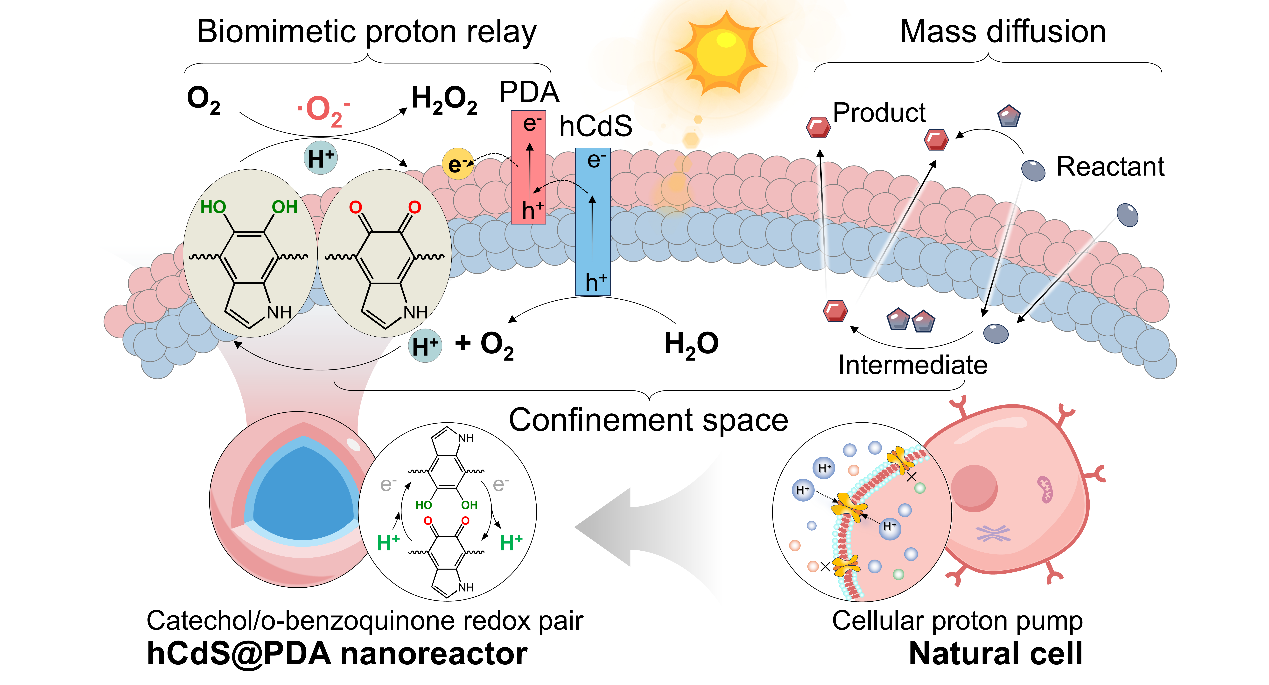
Schematic illustration of photocatalytic H2O2 synthesis over hollow CdS@polydopamine based on biomimetic proton relay machinery and nanoreactor engineering. (Image by LI Haitao)
<関連情報>
- https://english.cas.cn/newsroom/research-news/202607/t20260722_1178875.shtml
- https://pubs.acs.org/doi/10.1021/jacs.6c08170#
光触媒反応用ナノリアクターにおける生体模倣型酸化還元反応を介したプロトンリレー Biomimetic Redox-Mediated Proton Relay in Nanoreactors for Photocatalysis
Haitao Li,Mengyuan Ji,Jinlu He,Dehui Deng,Jincai Zhao,Jian Liu,and Can Li
Journal of the American Chemical Society Published: July 8, 2026
DOI:https://doi.org/10.1021/jacs.6c08170
Abstract
Mimicking the hierarchical compartmentalization and proton pump machinery of living cells in synthetic nanomaterials offers a promising route for sustainable photocatalysis. Here, we report a hollow CdS@polydopamine nanoreactor that integrates two biomimetic features: (i) A dynamic catechol/o-benzoquinone redox pair in the polydopamine shell that functions as a proton relay (rather than an active pump), accelerating proton-coupled electron transfer (PCET) by reversibly donating and accepting protons, and (ii) compartmentalized nanoreactor architecture comprising a porous shell-defined nanoscale cavity that creates confined microenvironments for mass diffusion, reactant enrichment, and photon trapping. This synergistic integration concurrently promotes both oxygen reduction and water oxidation half-reactions, achieving a record H2O2 photosynthesis rate (3.24 mmol gcat.–1 h–1) in aqueous solution under visible-light illumination, with a solar-to-chemical conversion efficiency of 1.2%. The combination of in situ spectroscopy, photochemical analysis, finite element simulations, and theoretical calculations visualizes the biomimetic machinery and elucidates the photocatalytic mechanism. Furthermore, encapsulation within an environmentally benign sodium alginate hydrogel matrix yields monolithic and recyclable photocatalysts capable of stable H2O2 synthesis under natural sunlight. This work will inspire a new generation of biomimetic nanomaterials that increasingly replicate the sophistication of living cells, opening frontiers in photosynthesis, energy catalysis, and synthetic chemistry.

