2025-10-29 名古屋大学
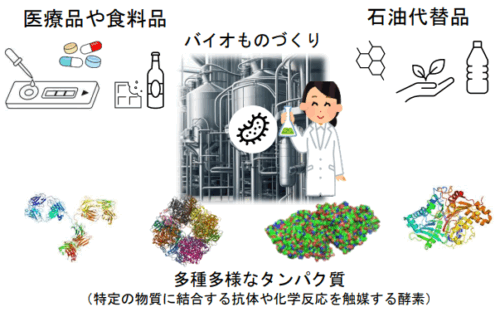
図 1. バイオものづくりを支えるさまざまなタンパク質
<関連情報>
- https://www.nagoya-u.ac.jp/researchinfo/result/2025/10/post-892.html
- https://www.nagoya-u.ac.jp/researchinfo/result/upload_images/20251029_agr.pdf
- https://pubs.rsc.org/en/content/articlelanding/2025/cb/d5cb00199d
大腸菌 におけるリボソームの停滞を軽減する翻訳促進ペプチドのスクリーニングと機械学習に基づく予測 Screening and machine learning-based prediction of translation-enhancing peptides that reduce ribosomal stalling in Escherichia coli
Teruyo Ojima-Kato, Gentaro Yokoyama, Hideo Nakano, Michiaki Hamada and Chie Motono
RSC Chemical Biology Published:22 Oct 2025
DOI:https://doi.org/10.1039/D5CB00199D
Abstract
We previously reported that the nascent SKIK peptide enhances translation and alleviates ribosomal stalling caused by arrest peptides (APs) such as SecM and polyproline when positioned immediately upstream of the APs in both Escherichia coli in vivo and in vitro translation systems. In this study, we conducted a comprehensive screening of translation-enhancing peptides (TEPs) using a randomized artificial tetrapeptide library. The screening focused on the ability of the peptides to suppress SecM AP-induced translational stalling in E. coli cells. We identified TEPs exhibiting a range of translation-enhancing activities. In vitro translation analysis suggested that the fourth amino acid in the tetrapeptide influences the reduction of SecM AP-mediated stalling. Additionally, we developed a machine learning model using a random forest algorithm to predict TEP activity, which showed a strong correlation with experimentally measured activities. These findings provide a compact peptide toolkit and a data-driven approach for alleviating AP-induced ribosome stalling, with potential applications in synthetic biology.