2025-11-27 大阪公立大学
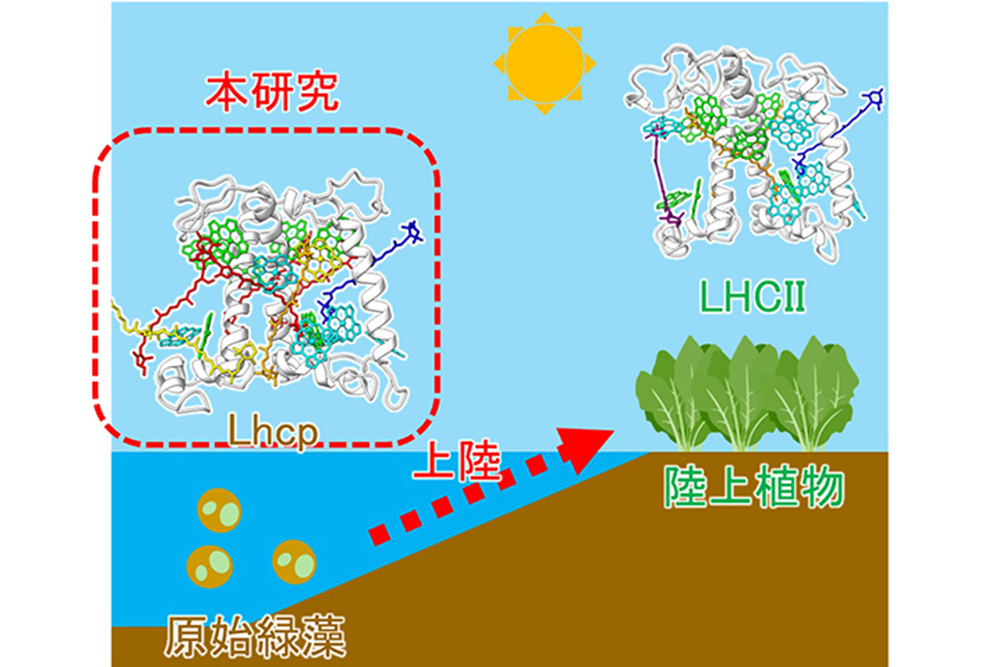
図:原始緑藻が生育する海中の弱光・青緑光環境から、陸上の強光・広帯域光環境への遷移に伴い、光合成アンテナLHCII(右上の構造)はその構造と機能を変化させてきた。本研究では、Lhcp(赤い点線で囲んだ構造)の構造解析を通じて、光合成装置の進化的適応戦略を構造レベルで明らかにした。
<関連情報>
- https://www.omu.ac.jp/info/research_news/entry-21189.html
- https://www.omu.ac.jp/assets/attachmentfile/attachmentfile-file-83319.pdf
- https://www.nature.com/articles/s42003-025-08977-x
プラシノ藻特有の光合成集光複合体Lhcpにおける特徴的かつ機能的な色素配列 Distinctive and functional pigment arrangements in Lhcp, a prasinophyte-specific photosynthetic light-harvesting complex
Soichiro Seki,Masato Kubota,Nami Yamano,Eunchul Kim,Asako Ishii,Tomoko Miyata,Hideaki Tanaka,Richard J. Cogdell,Jian-Ping Zhang,Keiichi Namba,Genji Kurisu,Jun Minagawa & Ritsuko Fujii
Communications Biology Published:17 November 2025
DOI:https://doi.org/10.1038/s42003-025-08977-x
Abstract
Light harvesting is essential for photosynthesis, and the diversity of light-harvesting systems enables photosynthetic organisms to acquire unique niches and thrive. Prasinophytes are marine green algae that diverge early in the evolution of photosynthetic eukaryotes and use a distinct light-harvesting complex known as Lhcp as their primary antenna. Lhcp consists of proteins and pigments unique to prasinophytes but shares some structural and functional features with the plant-type light-harvesting complex LHCII. Here, we use cryo-electron microscopy to determine the structure of Lhcp from the prasinophyte Ostreococcus tauri at 1.94 Å resolution, revealing all pigments responsible for light harvesting. The results show that the trimeric structure of Lhcp is stabilized by pigments, including a distinctive carotenoid identified as the cis-isomer of esterified antheraxanthin B. Comparison of Lhcp and plant-type LHCII reveals that while their core architecture is conserved, structural differences underlie their functional divergence. This work provides insight into the evolution of light-harvesting systems and highlights how structural diversity contributes to ecological adaptation.