2026-04-01 中国科学院(CAS)
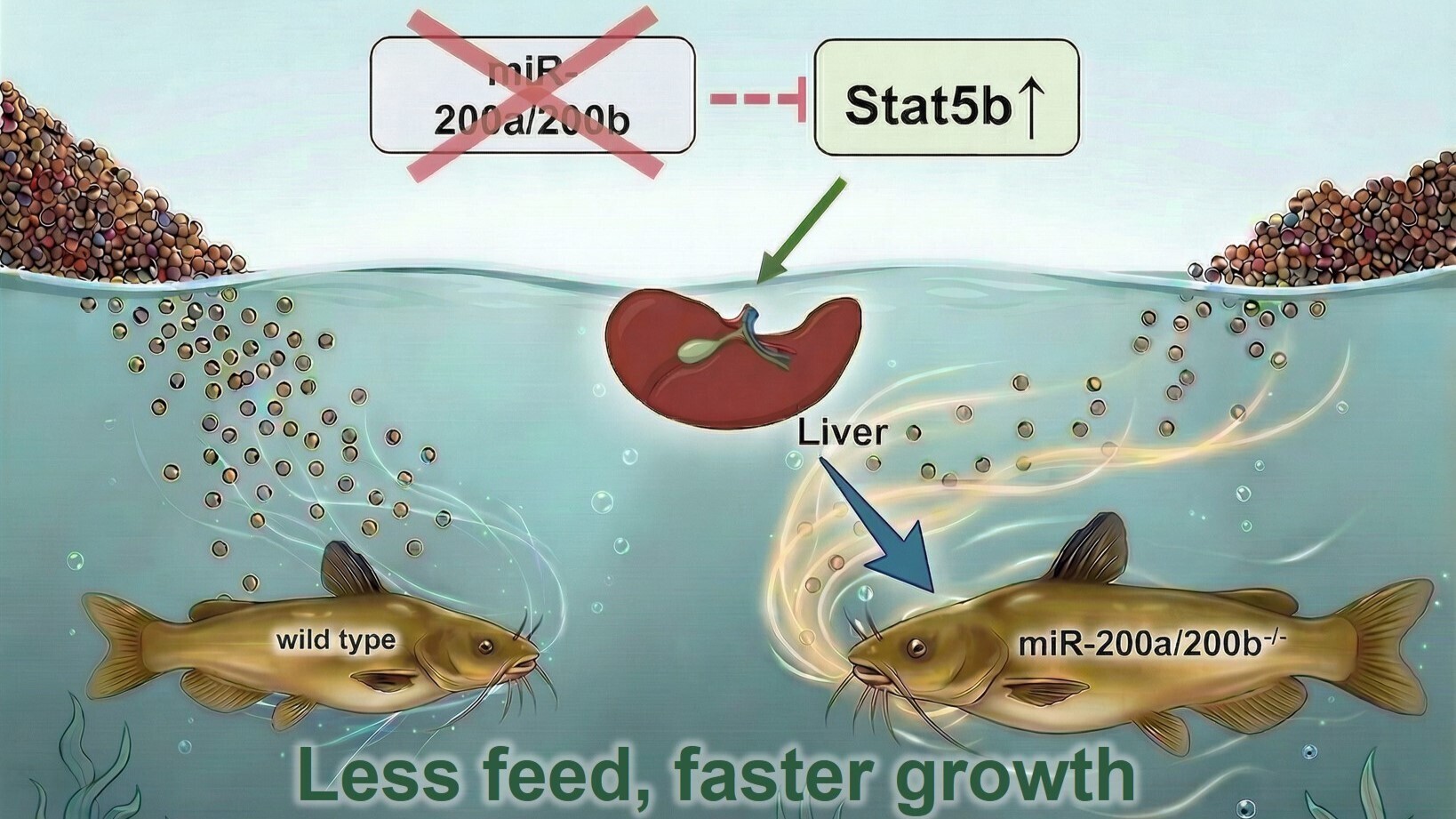
CRISPR-based editing improves catfish growth and nutrient use efficiency. (Image by IHB)
<関連情報>
- https://english.cas.cn/newsroom/research-news/202604/t20260401_1154975.shtml
- https://link.springer.com/article/10.1007/s11427-025-3249-5
miR-200a/200bの遺伝子欠損は、ナマズの成長と飼料効率を向上させる Genetic deletion of miR-200a/200b increases growth and feed conversion efficiency in yellow catfish
Xu Wang,Yan Xie,Qiaohong Lin,Yang Xiong,Ying Liu,Si Ge,Qiuen Tan,Zhipeng He,Youbo Jiang,Qingqing Han,Shuang Jin,Peipei Huang,Yuhong Wang,Wenjie Guo,Fan Ren,Jian-Fang Gui & Jie Mei
Science China Life Sciences Published:10 March 2026
DOI:https://doi.org/10.1007/s11427-025-3249-5
Abstract
The most effective approach for minimizing feed cost and maximizing animal production is the creation of breeding materials with simultaneous increases in growth and feed conversion efficiency (FCE). However, the key genes that regulate FCE are unknown. Here, we artificially selected specific strains of yellow catfish with simultaneous improvements in growth and FCE traits and then conducted a genome-wide association study to screen candidate SNPs and genes associated with these traits. A particular locus in the miR-200 cluster on chromosome 23 was identified, and the causal relationships between miR-200a/200b expression and growth/FCE were further validated. Genetic deletion of miR-200a/200b by CRISPR/Cas9 in yellow catfish significantly underpins phenotypic gains in growth and FCE by regulating genes involved in energy intake and energy metabolism without significantly affecting average feed intake or the expression of appetite-regulating genes. Several critical target genes of miR-200a/200b, such as stat5b and fasn, were identified via RNA-RNA pulldown and RNA-seq analyses, and stat5b-transgenic yellow catfish exhibited significantly increased growth and FCE. These findings highlight the pivotal role of the miR-200a/200b-stat5b signaling axis in controlling growth, metabolism, and FCE in yellow catfish, thus providing a strategy toward achieving more effective and sustainable animal agriculture by gene editing.