2026-04-09 イェール大学
<関連情報>
- https://medicine.yale.edu/news-article/diagnosing-dementia-neuroimaging-technique-could-speed-detection/
- https://alz-journals.onlinelibrary.wiley.com/doi/10.1002/alz.71283
行動型前頭側頭型認知症におけるシナプス密度イメージング:18F- SynVesT-1と18F -FDG PETの比較 Synaptic density imaging in behavioral variant frontotemporal dementia: A comparison of 18F-SynVesT-1 and 18F-FDG PET
Arman Fesharaki-Zadeh, Salih Cayir, Waleed Ibrahim, Yanghong Yang, Jean-Dominique Gallezot, Mika Naganawa, Yanjun Wu, Takuya Toyonaga, Faranak Ebrahimian Sadabad, …
Alzheimer’s & Dementia Published: 09 April 2026
DOI:https://doi.org/10.1002/alz.71283
Abstract
INTRODUCTION
Synapse loss, a key feature of behavioral variant frontotemporal dementia (bvFTD), can now be visualized in vivo using positron emission tomography (PET) that targets synaptic vesicle glycoprotein 2A (SV2A). Comparing this new imaging method with the clinical standard of glucose metabolism using 18F-fluorodeocyglucose (18F-FDG) PET might improve diagnostic accuracy and disease monitoring in bvFTD.
METHODS
We measured synaptic vesicle glycoprotein 2A (SV2A) binding using 18F-SynVesT-1 PET and glucose metabolism with 18F-FDG PET in 10 patients with bvFTD and 10 age-matched healthy controls.
RESULTS
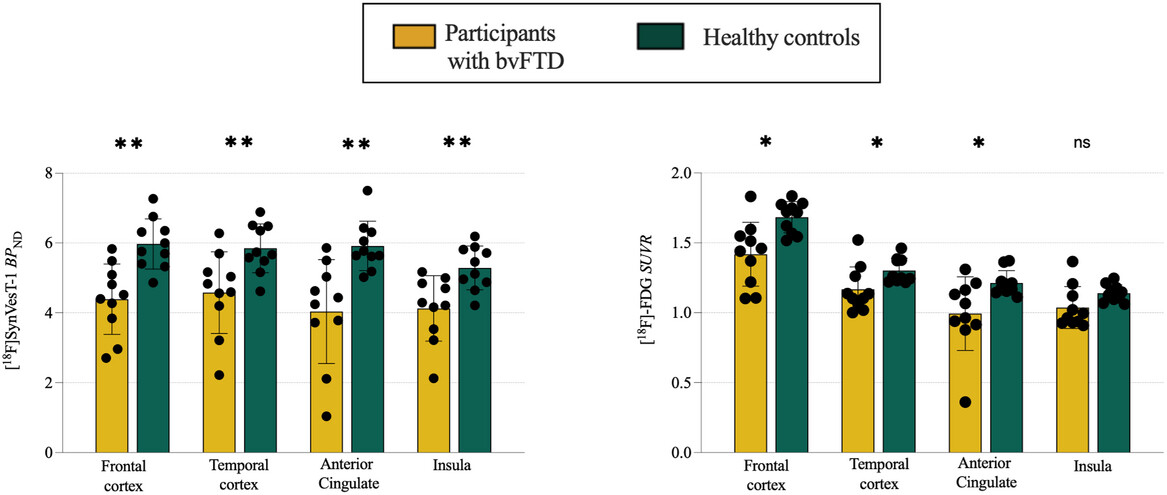
SV2A binding was significantly lower in the frontal and temporal cortices, anterior cingulate, and insula in bvFTD patients, with more widespread and pronounced differences than those observed with 18F-FDG PET. SV2A binding in the frontal cortex and insula significantly correlated with the Frontal Assessment Battery scores.
DISCUSSION
Our findings suggest that, in bvFTD, the degree of lower synaptic density, as measured by SV2A PET, is larger than the degree of hypometabolism as measured by 18F-FDG PET. SV2A imaging demonstrates considerable promise as a new in vivo biomarker for bvFTD.
Highlights
- Synaptic density positron emission tomography (PET) imaging using a protein abundantly expressed in virtually all synapses enables in vivo quantification of synapses and offers a direct window into synaptic pathology.
- Although 18F-fluorodeocyglucose (18F-FDG) PET is widely used in clinical practice to assess regional brain metabolism in behavioral variant frontotemporal dementia (bvFTD), it does not directly measure synaptic density and can be confounded by glial activity and other non-neuronal signals.
- This study provides the first direct comparison of synaptic vesicle glycoprotein 2A (SV2A) PET using 18F-SynVesT-1 and 18F-FDG PET in the same individuals with bvFTD
- Lower synaptic density was more pronounced than metabolic reduction across all bvFTD-affected regions and showed stronger correlations with executive dysfunction.
- These findings support SV2A PET as a sensitive biomarker in bvFTD, with strong potential for use in early diagnosis, progression tracking, and clinical trials targeting synaptic integrity.