2026-04-17 東京科学大学
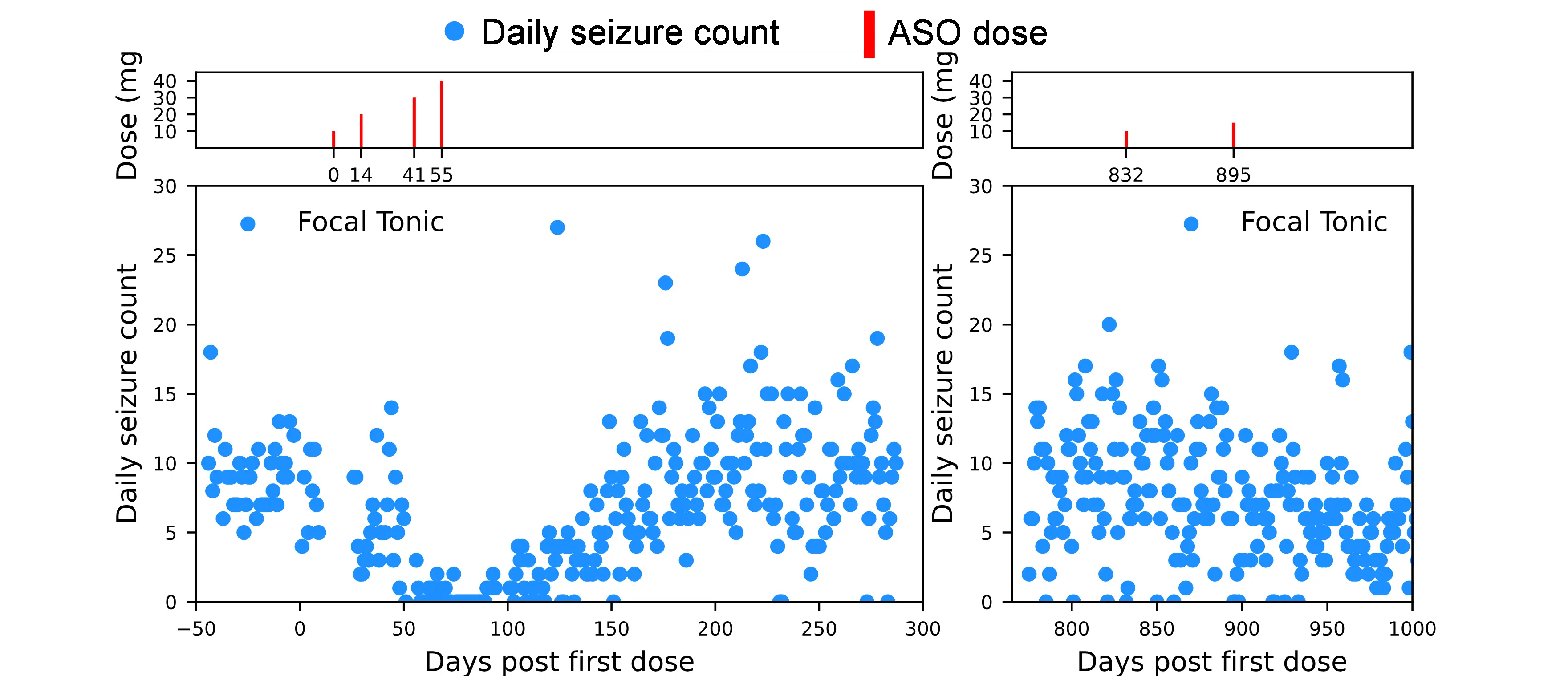
図1. 患者へのASO投与後、てんかん発作の頻度と強度の大幅な低下を認めた。
<関連情報>
重度のKCNT1てんかん性脳症の乳児2例に対するアンチセンスオリゴヌクレオチドを用いたノックダウン療法 Antisense oligonucleotide-mediated knockdown therapy in two infants with severe KCNT1 epileptic encephalopathy
Tojo Nakayama,Christelle M. El Achkar,Lisseth E. Burbano,Imran H. Quraishi,Jing Wu,Melody Li,Yutaro Asami,Sean R. Golinski,Emma Sherrill,Benjamin D. Goodlett,Claudio M. de Gusmao,Danielle A. Friedman,Claudia Lentucci,Victoria Suslovitch,Olivia Riccardi,Kamli N. W. Faour,Ashley Kuniholm,Aubrie Soucy Verran,Siobhan Coffman,Banu Ahtam,Boxun Zhao,Diana H. Chin,Renata L. DiDonato,Chunguang A. Hu,… Timothy W. Yu
Nature Medicine Published:14 April 2026
DOI:https://doi.org/10.1038/s41591-026-04314-9
Abstract
KCNT1-related epileptic encephalopathy, including epilepsy of infancy with migrating focal seizures, is a severe neurodevelopmental disorder associated with refractory seizures, profound neurologic impairment and premature death. It is caused by de novo genetic variants in KCNT1 that alter the function of Slack, an evolutionarily conserved sodium-gated potassium channel that modulates neuronal firing patterns and excitability. Pathogenic KCNT1 variants lead to overactive Slack channels, boosting total neuronal potassium currents by up to 40%, driving cortical hyperexcitability and causing seizures. Here we investigate antisense oligonucleotide-mediated KCNT1 knockdown as a therapeutic strategy for patients with epilepsy of infancy with migrating focal seizures. Intrathecal delivery of an experimental, non-allele-specific, KCNT1-targeting antisense oligonucleotide by lumbar puncture in two 2-year-old females with KCNT1 p.R474H, a severe, recurrent pathogenic variant, led to a significant reduction in seizure frequency and intensity. However, investigational treatment was also associated with the development of ventricular enlargement or hydrocephalus in both patients, prompting in one case the redirection of goals of care, pointing to a potential monitorable toxicity of some intrathecal antisense oligonucleotides.