2026-05-19 東北大学
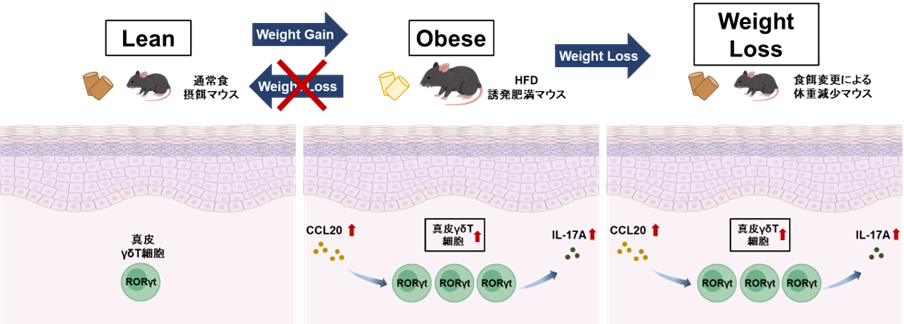
図1. 研究の概要 健康な皮膚(左:Lean)と比べ、肥満になった皮膚(中央:Obese)では、「炎症のスイッチ(CCL20、RORγt、IL-17A)」や真皮γδ T細胞が増加します。この増加は、減量後(右:WL)も、消えることなく皮膚に残り続けます。これが「肥満の記憶」であり、一度この記憶が刻まれると、次に刺激が加わったときに皮膚炎がひどく悪化してしまう原因となる可能性があります。
<関連情報>
- https://www.tohoku.ac.jp/japanese/2026/05/press20260519-04-cutaneous.html
- https://onlinelibrary.wiley.com/doi/full/10.1155/jimr/3930910/
高脂肪食による肥満は皮膚免疫細胞の機能を変化させ、これらの変化は減量後も持続する High Fat Diet-Induced Obesity Alters Cutaneous Immune Cell Function, and These Changes Persist After Weight Loss
Wakana Kamada, Hiromasa Tanno, Rena Takayashiki, Yuki Sato, Shinyo Ishi, Miki Shoji, Ko Sato, Tetsuji Aoyagi, Emi Kanno
Journal of Immunology Research Published: 15 May 2026
DOI:https://doi.org/10.1155/jimr/3930910
Abstract
Obesity is recognized as a chronic low-grade inflammation that contributes to metabolic disorders. Weight loss (WL) is well known to improve metabolic disorders. However, recent studies have shown that the changes in immune cells associated with obesity exhibit immunological memory even after WL. Obesity impairs skin barrier function and exacerbates inflammatory skin diseases, such as psoriasis. While skin immune cells maintain homeostasis and defense, the impact of obesity on these cells in intact skin is understudied, as research mainly focuses on skin with an inflammatory skin disease model in the context of obesity. The effect of WL on skin immunity is even less clear. Therefore, this study aimed to investigate these discrepancies. Mice were assigned to the lean group (regular diet), the obese group (high-fat diet for 18 weeks), and the WL group (high-fat diet for 9 weeks followed by regular diet for 9 weeks). Following 18 weeks of feeding, mouse skin was excised, and immune cell populations within the skin were analyzed using real-time PCR and flow cytometry. In addition, the effects of WL on psoriasis were examined using an imiquimod-induced psoriasis mouse model. We observed increased expression of RORγt, IL-17A, and CCL20 in intact skin in both the obese and WL groups. In the psoriasis model, disease severity was further exacerbated by WL. Moreover, whereas the Vγ4+Vγ5− γδ T cell population was increased in the lean group, the Vγ4−Vγ5− γδ T cell population remained elevated following WL, similar to levels observed in the obese group. These observations indicated that obesity may imprint a memorized immune response in the skin, which is not abrogated by WL. This study is the first to demonstrate this persistent effect on skin immunity. These findings imply that individuals who have experienced obesity may remain at increased risk for inflammatory skin conditions, even after WL.