2026-05-20 熊本大学
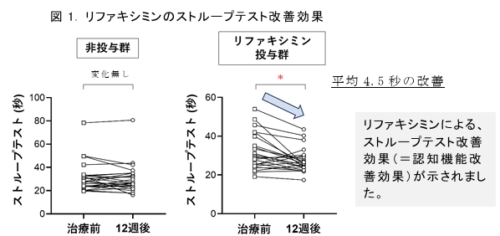
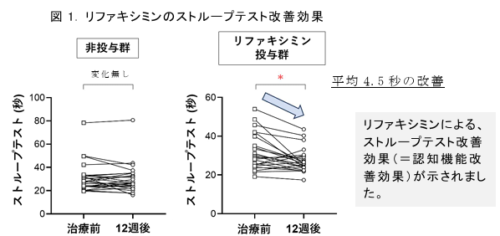
図 1. リファキシミンのストループテスト改善効果
<関連情報>
- https://www.kumamoto-u.ac.jp/whatsnew/seimei/20260520
- https://www.kumamoto-u.ac.jp/daigakujouhou/kouhou/pressrelease/wgt3jw/release260520.pdf
- https://onlinelibrary.wiley.com/doi/10.1111/apt.70712
リファキシミンは潜在性肝性脳症患者の認知機能を改善し、肝硬変関連の有害事象を軽減する:ランダム化比較試験 Rifaximin Improves Cognitive Performance and Reduces Cirrhosis-Related Adverse Events in Covert Hepatic Encephalopathy: A Randomized Controlled Trial
Hiroki Inada, Toshinori Toyota, Haruki Uojima, Etsuko Iio, Takao Miwa, Satoshi Miuma, Shiho Miyase, Takahiro Mizuta, Daiki Maeda, Katsuya Nagaoka, Satoshi Narahara, Sotaro Kurano ,…
Alimentary Pharmacology & Therapeutics Published: 06 May 2026
DOI:https://doi.org/10.1111/apt.70712
ABSTRACT
Background
Covert hepatic encephalopathy (CHE) is associated with cognitive impairment and adverse clinical outcomes; however, randomized evidence supporting therapeutic intervention remains limited.
Aim
To evaluate the efficacy of rifaximin (RFX) as a treatment for CHE.
Methods
In this multicentre, open-label randomized controlled trial, patients with CHE associated with liver cirrhosis were randomized (1:1) to receive RFX or no treatment and followed for 12 weeks. The primary endpoint was the change in Stroop test performance. Secondary endpoints included NCT-B scores, serum ammonia levels, cirrhosis-related adverse events, and gut microbiota composition.
Results
Fifty patients were randomized and completed follow-up. Stroop test performance improved significantly in the RFX group (p = 0.006) but not in controls (p = 0.400), with a trend toward greater improvement with RFX (Δ Stroop test: −4.45 ± 7.12 vs. −0.98 ± 5.74 s; p = 0.056). Among patients not receiving synthetic disaccharides at baseline, improvement was significantly greater with RFX (Δ Stroop test: −3.73 ± 5.96 vs. −0.80 ± 5.86 s; p = 0.049). No significant changes were observed in NCT-B scores or serum ammonia levels. Cirrhosis-related adverse events were significantly reduced in the RFX group (p = 0.006). Overall, gut microbial diversity did not differ between groups; however, RFX selectively altered specific taxa, including loss of the [Eubacterium] brachy group.
Conclusions
RFX improved cognitive performance assessed by the Stroop test and reduced cirrhosis-related adverse events in patients with CHE. These randomized data support RFX as an effective therapeutic option and highlight the Stroop test as a sensitive endpoint for treatment response.