
2026-05-26 カナダ・コンコルディア大学
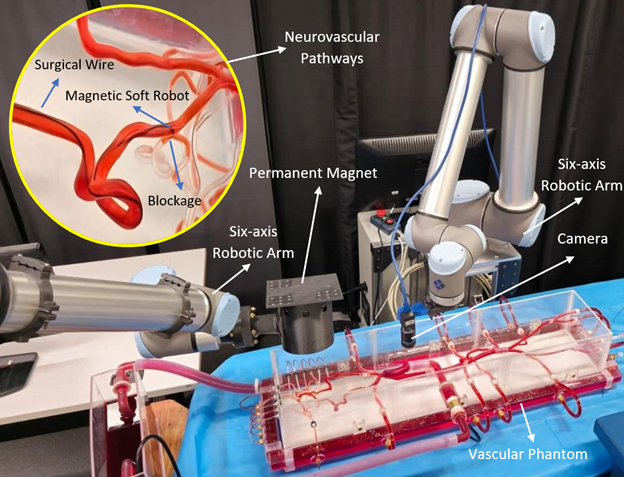
Overview of the developed robotic platform and its main subsystems, adapted from Alireza Moezi’s PhD thesis.
<関連情報>
- https://www.concordia.ca/news/stories/2026/05/26/magnet-guided-soft-robots-could-lead-to-safer-treatment-of-life-threatening-blood-clots-concordia-research-shows.html
- https://iopscience.iop.org/article/10.1088/1361-665X/ae2708
磁場勾配下における磁気活性軟質連続体ロボットのロボット支援追跡制御 Robotic-assisted tracking control of magnetoactive soft continuum robots in magnetic gradients
Alireza Moezi, Ramin Sedaghati and Subhash Rakheja
Smart Materials and Structures Published: 22 January 2026
DOI:10.1088/1361-665X/ae2708
Abstract
Stroke and other neurovascular disorders demand advanced biomedical technologies capable of precise operation in confined anatomical environments. Magnetoactive soft continuum robots (MSCRs) offer flexibility and magnetic responsiveness for minimally invasive interventions, yet real-time control under nonuniform magnetic fields remains challenging. This study presents a novel robotic-assisted, closed-loop feedforward–feedback proportional–integral–derivative (FFPID) control strategy for accurate tip deflection and trajectory tracking of MSCRs actuated by a rotatable permanent magnet. A nonlinear quasi-static model of the MSCR is first developed to account for the effects of magnetic torque, magnetic body force, and gravity. The model is further extended to simulate MSCR behavior in a fluidic environment, better reflecting physiological vascular conditions. The external nonuniform magnetic field generated by a permanent magnet is modeled using finite element (FE) simulations in COMSOL Multiphysics and experimentally validated. A deep neural network trained on the FE dataset is utilized to efficiently predict 2D magnetic field magnitudes and gradients, providing real-time inputs to the quasi-static model. The developed model is subsequently employed to fine-tune the coefficients of the proposed FFPID control algorithm. The MSCR is fabricated and characterized through mechanical and magnetic testing, and a dedicated experimental platform is developed to evaluate its performance in both ambient and fluidic environments under varying magnetic gradients and fluid flow rates. A multi-tracker Eye-to-Hand calibration framework is implemented to ensure magnetic field alignment. Moreover, a trained deep learning–based model is developed for MSCR detection and deformation estimation. Four hardware-in-the-loop experiments are conducted using a six-degree-of-freedom robotic arm to assess the controller’s performance across different MSCR materials and boundary configurations. The results demonstrate the robustness and precision of the proposed FFPID control strategy across various experimental conditions, including operation under different fluid flow rates. The controller consistently outperforms the conventional PID in tracking experiments, highlighting its strong potential for real-time, robot-assisted neurovascular applications.

