2026-06-12 中部大学
<関連情報>
- https://www.chubu.ac.jp/news/57848/
- https://academic.oup.com/pcp/advance-article/doi/10.1093/pcp/pcag052/8695180
サイトカイニン受容体AHK3は、木部におけるトランスゼアチン型サイトカイニンのレベル を調節することにより、葉の大きさに影響を与える Cytokinin receptor AHK3 influences leaf size by modulating trans-zeatin-type cytokinin levels in xylem
Kota Monden,Takamasa Suzuki,Mikiko Kojima,Yumiko Takebayashi,Takehiro Kamiya,Takatoshi Kiba,Hitoshi Sakakibara,Tsuyoshi Nakagawa,Takushi Hachiya
Plant & Cell Physiology Published:12 June 2026
DOI:https://doi.org/10.1093/pcp/pcag052
Abstract
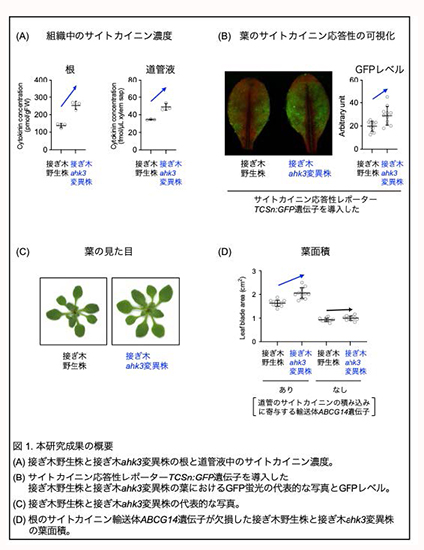
Trans-zeatin (tZ)-type cytokinins (CKs) are predominantly synthesized in roots, transported to the shoot via the xylem, and coordinate diverse physiological processes in aerial organs. Within this process, the regulation of CK biosynthesis by nitrate signaling via nodule inception-like protein 7, as well as the loading of tZ-type CKs into the xylem by ATP-binding cassette transporter G14, have been well studied. However, the roles of other components remain unclear. Here, we show that CK perception and degradation in roots, as mediated by Arabidopsis histidine kinase 3 (AHK3) and CK oxidase/dehydrogenase 4 (CKX4), modulate root-to-shoot tZ-type cytokinin transport in response to nitrate. Grafting experiments demonstrate that root-specific AHK3 deficiency systemically increases the leaf blade area through long-distance signals of root-derived tZ-type CKs, perceived by shoot-expressed AHK3. Transcriptome and hormonome analyses reveal that root-specific AHK3 deficiency reduces CKX4 expression in roots, elevating tZ-type CK levels in roots and xylem sap and thereby enhancing the leaf CK response. Transfer experiments manipulating root nitrate levels show that root-specific AHK3 deficiency promotes the leaf blade area in a manner dependent on both nitrate and root-derived tZ-type CK signaling. Moreover, both nitrate signals and root-expressed AHK3 are required for maximal CKX4 induction in roots, and root-specific CKX4 deficiency enhances the leaf blade area in a nitrate-dependent manner. These findings reveal a novel mechanism in which an AHK3–CKX4 module governs xylem transport of tZ-type CKs, fine-tuning leaf size according to root nitrate status.