2026-06-10 マサチューセッツ工科大学(MIT)
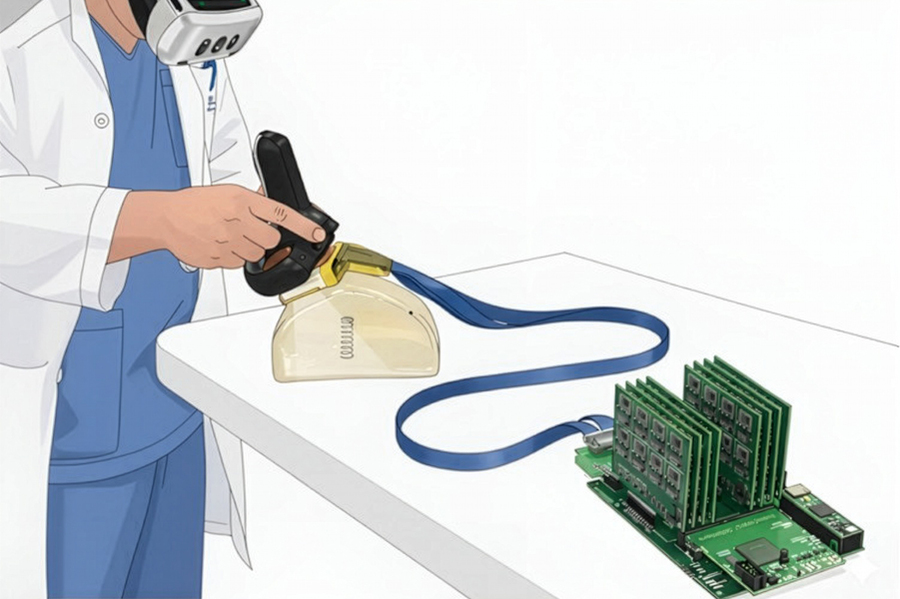
MIT researchers have developed a new approach to ultrasound imaging that allows the user to visualize a 3D augmented-reality image of the object being scanned. Using a virtual-reality headset, they can see a precise 3D digital representation of what the object actually looks like, making it easier to identify and analyze. Credit: Courtesy of the researchers
<関連情報>
- https://news.mit.edu/2026/augmented-reality-system-could-make-medical-ultrasounds-easier-to-interpret-0610
- https://www.nature.com/articles/s44172-026-00692-7
拡張現実におけるリアルタイム3D超音波は、トレーニングを加速させ、初心者と熟練者のパフォーマンスの差を縮める Real-time 3D ultrasound in augmented reality accelerates training and narrows novice–expert performance gaps
Jason F. Hou,Shrihari Viswanath,Cinay Dilibal,Bowen Wu,Tanisha Shende & Canan Dagdeviren
Communications Engineering Published:10 June 2026
DOI:https://doi.org/10.1038/s44172-026-00692-7
Abstract
Ultrasound imaging requires users to infer three-dimensional anatomy from two-dimensional slices, imposing steep training demands that limit broader adoption. Here we present AR-VIU, a mixed-reality platform that streams real-time volumetric ultrasound as point-cloud renderings into an augmented-reality headset with true-scale spatial registration. To isolate the contributions of volumetric imaging and immersive display, we tested four conditions—two-dimensional imaging on a screen, two-dimensional imaging in augmented reality, three-dimensional imaging on a screen, and three-dimensional imaging in augmented reality—in a controlled study with 18 participants (9 novices, 9 experts). Participants performed object recognition and localization tasks. The augmented-reality volumetric system was associated with the highest accuracy, lowest variability, and near-elimination of the novice-expert performance gap. These results demonstrate technical feasibility for real-time three-dimensional ultrasound in mixed reality and establish an evaluation framework for perceptual and cognitive performance in clinically relevant scenarios, with near-term applications in training and education.