2026-06-15 ハーバード大学
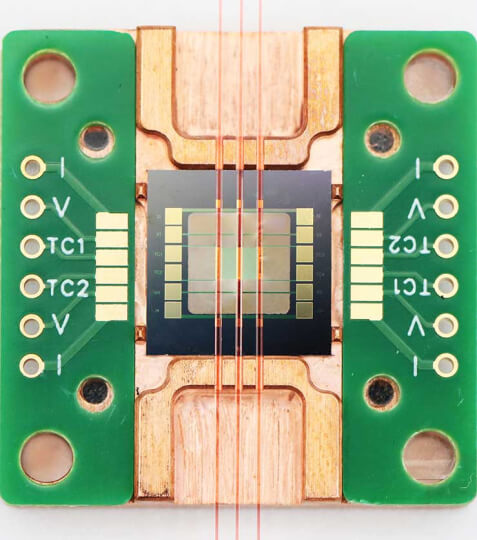
The pico-calorimeter assembled on a metal mount with a custom printed circuit board.
<関連情報>
- https://seas.harvard.edu/news/heat-sensor-living-cells
- https://www.pnas.org/doi/10.1073/pnas.2603171123
細胞代謝および抗菌薬感受性試験用のピコカロリメーター A pico-calorimeter for cellular metabolism and antimicrobial susceptibility testing
Juanjuan Zheng juanzheng@g.harvard.edu, Hang Yang, Adam Strandberg, +3 , and Joost J. Vlassak
Proceedings of the National Academy of Sciences Published:June 15, 2026
DOI:https://doi.org/10.1073/pnas.2603171123
Significance
Direct measurement of metabolic activity in living systems remains challenging, particularly at very low cell numbers where existing techniques lose sensitivity. We present a capillary pico-calorimetry technique that enables real-time, label-free measurement of metabolic heat with picowatt sensitivity from nanoliter-scale volumes. This technique is applied to quantify bacterial metabolic activity, infer growth dynamics, and detect antibiotic-induced metabolic inhibition in samples containing only tens of initial cells. By providing continuous metabolic readouts at low biomass and extending calorimetric measurements into regimes inaccessible to optical assays, this work establishes a quantitative framework for metabolism-based antimicrobial susceptibility testing and for broader studies of cellular energetics.
Abstract
While methods exist to indirectly quantify the metabolism of biological systems, directly measuring metabolic rates in living samples remains challenging. Here, we describe a calorimetric sensor with a sensitivity of ~100 pW at 23.1 mHz, suitable for measurements on living organisms, surpassing previously reported sensitivities. The sensor measures minute temperature differences between a capillary that contains the sample and two reference capillaries, directly relating this temperature difference to the heat produced by the sample. The sensor provides high responsivity (23 to 100 nV/nW), a fast thermal response time (~7.9 s), and supports real-time, long-term monitoring of biological processes, such as the proliferation and growth of small numbers of bacteria. These capabilities offer opportunities to advance our understanding of complex biological phenomena. We demonstrate the utility of the sensor by measuring the growth rate of Escherichia coli. The technique enables estimation of the oxygen consumption rate per cell, the heat production per cell, and the associated contributions from respiration and fermentation. We further show how the growth rate changes in response to different concentrations of chloramphenicol, rifampicin, and ampicillin, three antibiotics with distinct mechanisms of action. The sensor shows significant potential for determining the minimum inhibitory concentrations of antibiotics, performing antibiotic susceptibility testing of pathogens, and enabling fundamental studies of microorganism metabolism.
液体サンプル用マイクロマシン加工ピコカロリメータセンサー(化学反応および生化学への応用) A Micromachined Picocalorimeter Sensor for Liquid Samples with Application to Chemical Reactions and Biochemistry
Jinhye Bae, Juanjuan Zheng, Haitao Zhang, Peter J. Foster, Daniel J. Needleman, Joost J. Vlassak
Advanced Science Published: 12 January 2021
DOI:https://doi.org/10.1002/advs.202003415
Abstract
Calorimetry has long been used to probe the physical state of a system by measuring the heat exchanged with the environment as a result of chemical reactions or phase transitions. Application of calorimetry to microscale biological samples, however, is hampered by insufficient sensitivity and the difficulty of handling liquid samples at this scale. Here, a micromachined calorimeter sensor that is capable of resolving picowatt levels of power is described. The sensor consists of low-noise thermopiles on a thin silicon nitride membrane that allow direct differential temperature measurements between a sample and four coplanar references, which significantly reduces thermal drift. The partial pressure of water in the ambient around the sample is maintained at saturation level using a small hydrogel-lined enclosure. The materials used in the sensor and its geometry are optimized to minimize the noise equivalent power generated by the sensor in response to the temperature field that develops around a typical sample. The experimental response of the sensor is characterized as a function of thermopile dimensions and sample volume, and its capability is demonstrated by measuring the heat dissipated during an enzymatically catalyzed biochemical reaction in a microliter-sized liquid droplet. The sensor offers particular promise for quantitative measurements on biological systems.