2026-06-15 東京大学
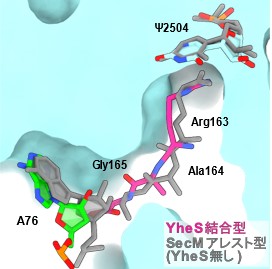
YheSによってアレストが解除されたSecMペプチドの構造
<関連情報>
YheSを介したSecMによって停止したリボソームの放出に関する構造的知見 Structural insights into YheS-mediated release of SecM-arrested ribosome
Kaishi Iso (依宋 海志),Toma Ikeda (池田 刀麻),Kohei Yamasaki,Yushin Ando,Fumiya K. Sano,Tadaomi Furuta (古田忠臣),Hideki Taguchi,Osamu Nureki,Yuhei Chadani (茶谷悠平) & Yuzuru Itoh (伊藤 弓弦)
Nature Communications Published:09 June 2026
DOI:https://doi.org/10.1038/s41467-026-72863-1
Abstract
ATP-binding cassette subfamily F (ABCF) proteins interact with the ribosome to resolve translation defects near the peptidyl transferase center (PTC). In Escherichia coli, four ABCF proteins (EttA, Uup, YbiT, and YheS) selectively promote translation of distinct problematic nascent peptide sequences, but their molecular mechanisms remain unclear. Here, we present a 2.8 Å cryo-EM structure of the ribosome in complex with an ATPase-deficient mutant of YheS and investigate how it releases ribosomes arrested by the SecM nascent chain. YheS binds to the ribosomal E-site via the L1 stalk, and its P-site tRNA-interaction motif (PtIM) extends toward the PTC, displacing the CCA end of the P-site tRNA. Notably, the cryo-EM density corresponding to the SecM nascent chain within the exit tunnel is largely lost upon YheS binding. These observations suggest that YheS relieves peptide sequence-dependent stalling by perturbing nascent chain-tunnel interactions through P-site tRNA relocation. Steered molecular dynamics simulations provide qualitative support for this model. Together, our findings provide mechanistic insight into a mode of arrest release distinct from the translocon-mediated release mechanism.