2026-15-22 ジョージア工科大学
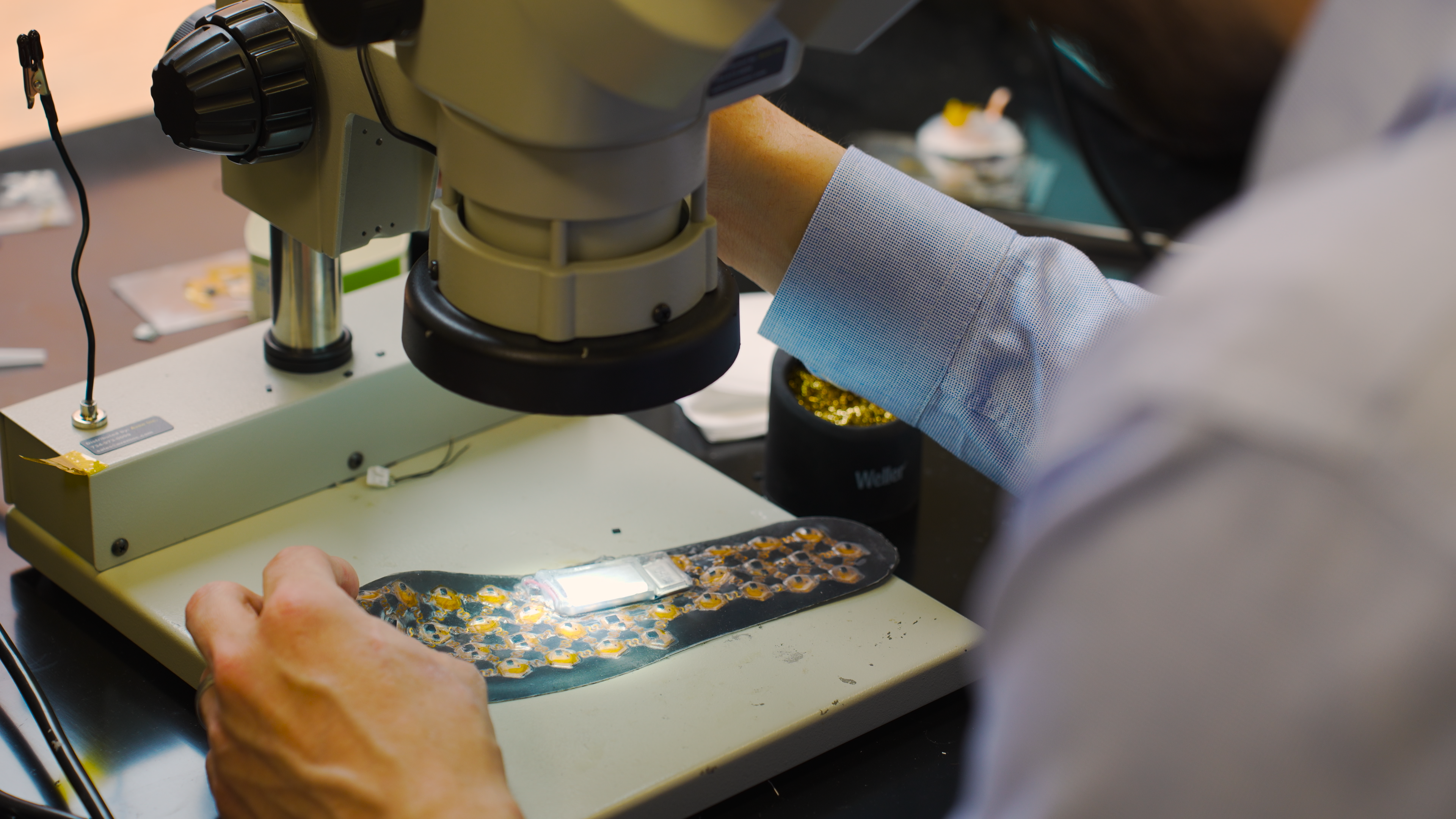
The system converts pressure underfoot into vibration and heat felt elsewhere on the body, helping people with sensory loss regain awareness of their footing and improve balance.
<関連情報>
- https://research.gatech.edu/new-wearable-reroutes-lost-sensation-restores-stability
- https://www.pnas.org/doi/10.1073/pnas.2536577123
足底感覚代替のためのマルチモーダル触覚アレイのスケーラブルなネットワーク Scalable networks of multimodal haptic arrays for plantar sensory substitution
Matthew T. Flavin, Yu-Ting Huang, Dimitrios Simatos, +17 , and John A. Rogers
Proceedings of the National Academy of Sciences Published:June 15, 2026
DOI:https://doi.org/10.1073/pnas.2536577123
Significance
The sense of touch in our feet is essential for safe movement, and its impairment in conditions such as stroke and spinal cord injury contributes to diminished quality of life. Substituting missing foot sensation requires not only sensors for reading that information but also a nonintrusive means to display it in real time. This article demonstrates a system of wireless, skin-conformable haptic arrays. A hybrid motor unit addresses long-standing challenges in the integration of high-resolution, multimodal haptics, delivering precise patterns of heat and vibration and giving the user more information about their physical environment. Systematic human perception experiments and case studies with sensory-impaired individuals establish foundational principles, raising implications for sensory symptoms affecting a large portion of the global population.
Abstract
Feet provide essential sensory input, supporting body awareness for safe movement. The impairment of plantar sensation, arising in conditions such as stroke and spinal cord injury, has a major impact on mobility, balance, and quality of life. Substituting the sensation of plantar pressure to another area on the body with intact somatosensory abilities requires capabilities for fast, programmable delivery of haptic feedback. Here, we introduce a wireless network of skin-conformable, multimodal haptic arrays that deliver high-density thermal and vibrotactile patterns anywhere on the body. Central to this approach is a hybrid motor unit that independently controls thermal and mechanical stimulation, enabling 128 degrees of freedom across 64 addressable nodes. Electromechanical characterization establishes precise, simultaneous, and safe modulation of both modalities. Psychophysical experiments demonstrate reliable spatial discrimination of colocated heat and vibration. These haptic arrays form the receivers in a sensory substitution system that delivers patterns of vibrotactile stimulation to mirror the distribution of pressure recorded from an insole-based array of pressure sensors. Exploratory case studies in individuals with spinal cord injury and stroke demonstrate feasibility and suggest improved performance during standing balance and walking tests. Altogether, this work highlights the potential of information-rich cutaneous interfaces to substitute plantar sensation, expanding the scope of somatosensory engagement for rehabilitation, entertainment, and education.