2026-09-05 大阪大学
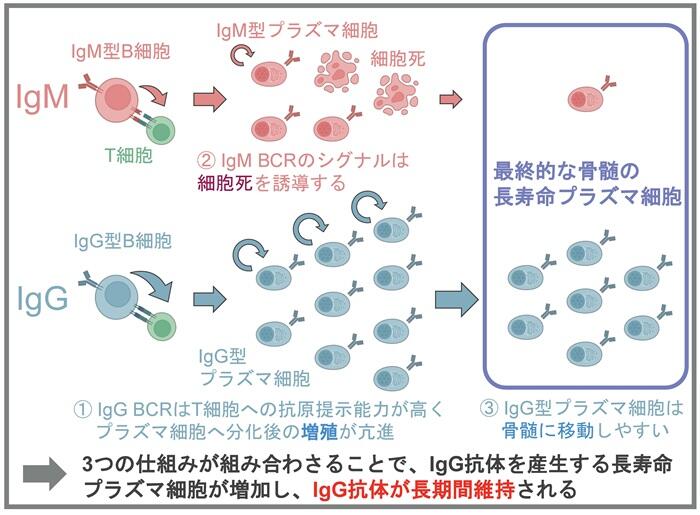
図: 本研究のまとめ
<関連情報>
- https://www.ifrec.osaka-u.ac.jp/jpn/research/20260905-0700.htm
- https://www.science.org/doi/10.1126/sciimmunol.aee8841
BCRアイソタイプ特異的抗原提示およびシグナル伝達によるIgG形質細胞のIgM形質細胞に対するポジティブセレクション Positive selection of IgG over IgM plasma cells through BCR isotype–specific antigen presentation and signaling
Yuki Tai, Takuya Koike, Hiromi Yamamoto, Kyoko Shida, […] , and Tomohiro Kurosaki
Science Immunology Published:4 Sep 2026
DOI:https://doi.org/10.1126/sciimmunol.aee8841
Abstract
During a primary immune response, B cells can undergo isotype switching from an immunoglobulin M (IgM) B cell receptor (BCR) to an IgG BCR. B cells that have switched to IgG give rise to more bone marrow long-lived plasma cells (PCs) compared with those expressing IgM, but how BCR isotype–driven bias occurs remains unclear. Here, we found that IgG1-expressing germinal center B cells presented higher levels of antigen to T follicular helper cells, resulting in greater proliferation of IgG1 PCs than IgM PCs. BCR signaling through IgM induced more Bim-dependent apoptosis in IgM PCs, together leading to the predominance of IgG1 PCs in secondary lymphoid tissues. In addition, IgG1 PCs were more prone to migrating to bone marrow. Hence, our findings suggest that isotype-specific differences in antigen presentation and BCR signaling contribute to the enrichment of IgG1 PCs in the bone marrow long-lived PC compartment.