2026-06-09 国際医療福祉大学,国立循環器病研究センター,日本医療研究開発機構
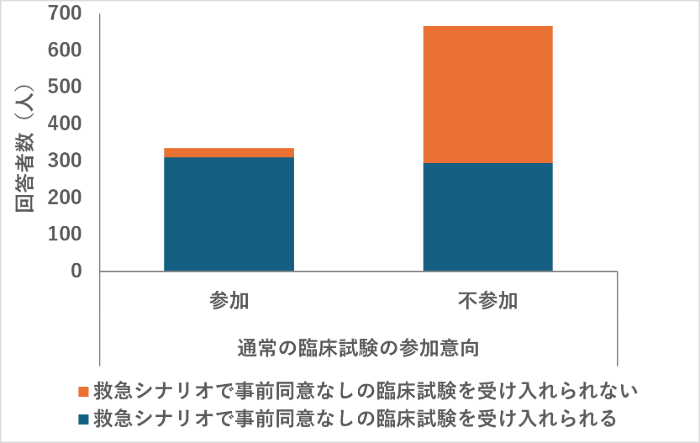
図 救急シナリオでの事前同意なし研究の受け入れと、通常の臨床試験への参加意向
<関連情報>
- https://www.ncvc.go.jp/pr/release/pr_52805/
- https://jamanetwork.com/journals/jamanetworkopen/fullarticle/2849955
脳卒中における事前同意なしの緊急研究に対する一般市民の受容 Public Acceptance of Emergency Research Without Prior Consent in Stroke
Masaru Suzuki, MD, PhD; Mayumi Fukuda-Doi, MD; Haruko Yamamoto, MD et al
Public Acceptance of Emergency Research Without Prior Consent in Stroke. JAMA Network Open. 2026;9(6):e2617347.
doi:10.1001/jamanetworkopen.2026.17347
Key Points
Question Is emergency research without prospective consent (ERWPC) for hyperacute stroke acceptable to the public in Japan, where no established pathway exists?
Findings In this survey study involving 1000 adults in Japan, 60.5% accepted ERWPC in at least 1 hypothetical stroke trial scenario, whereas 33.4% were willing to join a standard trial that required prospective informed consent. ERWPC acceptance was associated with benefit-risk considerations, research familiarity, and consent modality preferences.
Meaning These findings suggest that responses to emergency research may differ from general attitudes toward trial participation.
Abstract
Importance When prospective informed consent is not feasible in time-sensitive emergencies, such as hyperacute ischemic stroke, international ethics guidance recognizes that enrollment without prior consent may be permissible. Little is known about public acceptance of emergency research without prospective consent (ERWPC) in countries lacking established pathways.
Objectives To estimate public acceptance of ERWPC for hyperacute ischemic stroke, to identify factors associated with ERWPC acceptance, and to compare these factors with those associated with willingness to participate in a standard stroke randomized clinical trial (RCT) requiring prospective informed consent.