

2025-11-27 東京大学
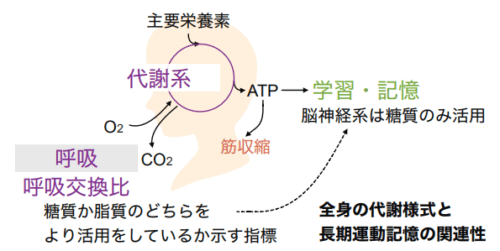
呼気ガスから算出される呼吸交換比は長期的な運動記憶を反映する
<関連情報>
- https://www.u-tokyo.ac.jp/content/400275555.pdf
- https://physoc.onlinelibrary.wiley.com/doi/10.1113/JP289233
全身代謝状態と長期運動記憶の関連:呼吸交換比とグルコース操作からの知見 Linking systemic metabolic state to long-term motor memory: Insights from respiratory exchange ratio and glucose manipulation
Takuji Hayashi, Nobuyasu Nakano, Sohei Washino, Akihiko Murai
The Journal of Physiology Published: 26 November 2025
DOI:https://doi.org/10.1113/JP289233
Abstract
Respiration is a crucial metabolic process that converts macronutrients, carbohydrates and fats, and oxygen into energy and carbon dioxide to support motor actions. Moreover, the brain is a significant energy consumer, accounting for large portions of the body’s total energy expenditure and relying primarily on carbohydrates for neural activity and plasticity. However, it is not known whether gas composition in breathing can serve as an indicator of neural activity and plasticity as they can for movement intensity. In human reaching movement tasks, we evaluated time-constants of sensorimotor learning during the recording of gas exchange. We computed the respiratory exchange ratio (RER), indicating whether carbohydrate or fat is used preferentially, and found that the RER was unaffected by the execution and learning of reaching movements and that it was stable within but varied across individuals. Interestingly, using computational modelling to identify short and long-time constants of sensorimotor learning, individual RER levels correlated with the estimated slow component of learning dynamics, suggesting a link between metabolic state and processes underlying long-term retention. To probe this further, we used glucose administration, known to increase RER by promoting carbohydrate utilisation, before training. Regression analysis indicated that glucose-induced RER increases during training were associated with enhanced estimated 24 h retention at the intra-individual level. Together, RER is associated with processes underlying long-term memory acquisition and retention, and glucose administration shifted the physiological idling state for the processes. Unravelling the specific neurobiological pathway from these intriguing breathing metrics to brain function emerges as a compelling new research direction.

Key points
- The brain is a major energy consumer (20% of total energy from only 2% of body weight), primarily using carbohydrates for neural activity and plasticity.
- The respiratory exchange ratio (RER) in breath signals the body’s balance of fat-carbohydrate fuel use; this study explored whether RER reflects neural processes in motor memory acquisition and retention.
- Individual RER, stable during reaching tasks but varying across participants, correlated with the computationally estimated slow component of learning dynamics, which is linked to long-term retention.
- Glucose administration, known to increase RER, was associated with improved estimated 24 h motor memory retention at an individual level.
- The results suggest that RER indicates long-term motor memory processes and that manipulating RER via glucose may enhance motor memory, offering a new neurobiological pathway from these intriguing breathing metrics to memory function and potential practical implications for a simple but plausible intervention.
