2025-07-02 マックス・プランク研究所
<関連情報>
- https://www.mpg.de/25020718/0702-bild-virtual-forest-bathing-alleviates-stress-149835-x
- https://www.sciencedirect.com/science/article/abs/pii/S0272494425001203
- https://www.nature.com/articles/s41467-025-56870-2
急性ストレス後の情動と認知の回復を促進するVR森林浴のマルチモーダル vs ユニモーダル Multi- vs. unimodal forest-bathing in VR to enhance affective and cognitive recovery after acute stress
Leonie Ascone, Fariba Mostajeran, Anna Mascherek, Nour Tawil, Thiemo Knaust, Larissa Samaan, Simone Kühn
Journal of Environmental Psychology Available online: 27 May 2025
DOI:https://doi.org/10.1016/j.jenvp.2025.102637
Highlights
- Multi-vs. unimodal 360° forest-VR boosts positive affect and nature connectedness.
- Partial superiority in working memory for multimodal vs. unimodal VR.
- No superiority for task switching, inhibition, or negative affect.
- Multimodal forest-VR has domain-specific effects (positive outcomes).
- Multimodal forest-VR may aid well-being where real nature is unavailable.
Abstract
Background
Forest-bathing has demonstrated beneficial effects on mental health. In virtual settings, more research is needed to determine whether such effects can be enhanced through multimodal stimulation. This pilot study used visual [V] (360° stereoscopic VR of a Douglas fir forest), auditory [A] (mostly birdsong) recordings, and olfactory [O] stimulation (Douglas fir), presented either unimodally ([V], [O], [A]) or in combination ([VOA]). The potential superiority of the multimodal [VOA] condition in promoting affective and cognitive recovery after stress was tested.
Methods
N = 136 healthy adults were randomly assigned to one of the four conditions. After a calm-breathing baseline and pre-assessment of affect, participants underwent a passive stress induction (image-viewing task), followed by a reassessment of affect and a first cognitive test block (Trail Making Test [executive function], color Stroop [inhibition], Digit Span backward [working memory]). Subsequently, they were exposed to the forest-stimulation phase. Affect and cognitive performance were reassessed post-intervention. Superiority of the VOA condition in recovery was analyzed using structural equation modeling (SEM), suited to model and test supra-additive effects.
Results
All groups showed significant stress recovery. The multimodal condition [VOA] demonstrated partial superiority, with selective benefits for positive affect and nature connectedness, but not for negative affect. In the cognitive domain, no broad multimodal advantage emerged, although working memory (Digit Span backward) was significantly more improved in VOA compared to the auditory condition.
Conclusion
Multimodal virtual forest bathing may enhance positive affect and nature connectedness, but its benefits appear domain-specific rather than general. There was limited evidence for cognitive enhancement, restricted to working memory. Future research should focus on enhancing sensory immersion, refining outcomes, and ensuring sufficient statistical power (n ≈ 44–48 participants per group) based on observed small-to-moderate effect sizes.
自然への曝露は、侵害受容関連の神経処理に作用して鎮痛効果を誘発する Nature exposure induces analgesic effects by acting on nociception-related neural processing
Maximilian O. Steininger,Mathew P. White,Lukas Lengersdorff,Lei Zhang,Alexander J. Smalley,Simone Kühn & Claus Lamm
Nature Communications Published:13 March 2025
DOI:https://doi.org/10.1038/s41467-025-56870-2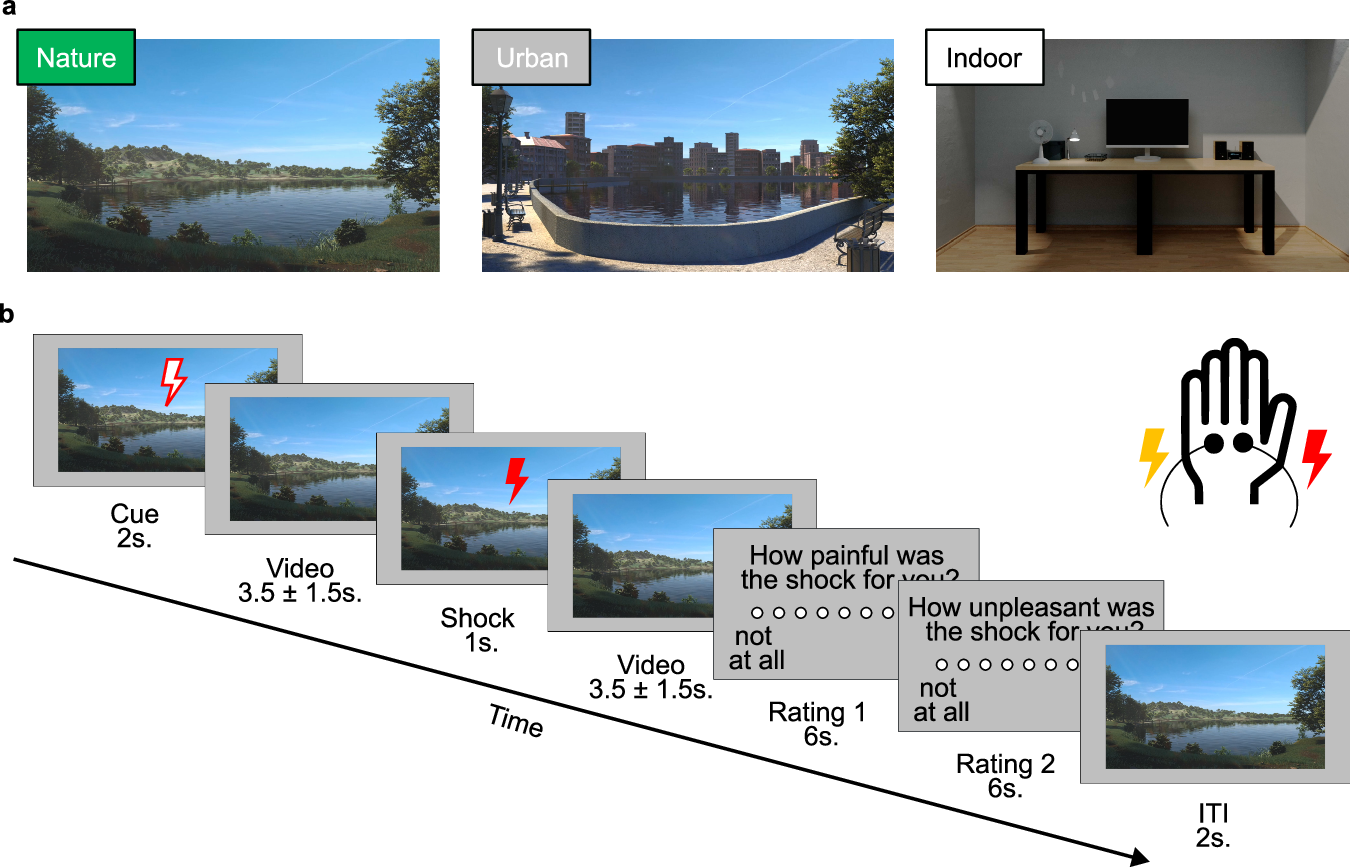
Abstract
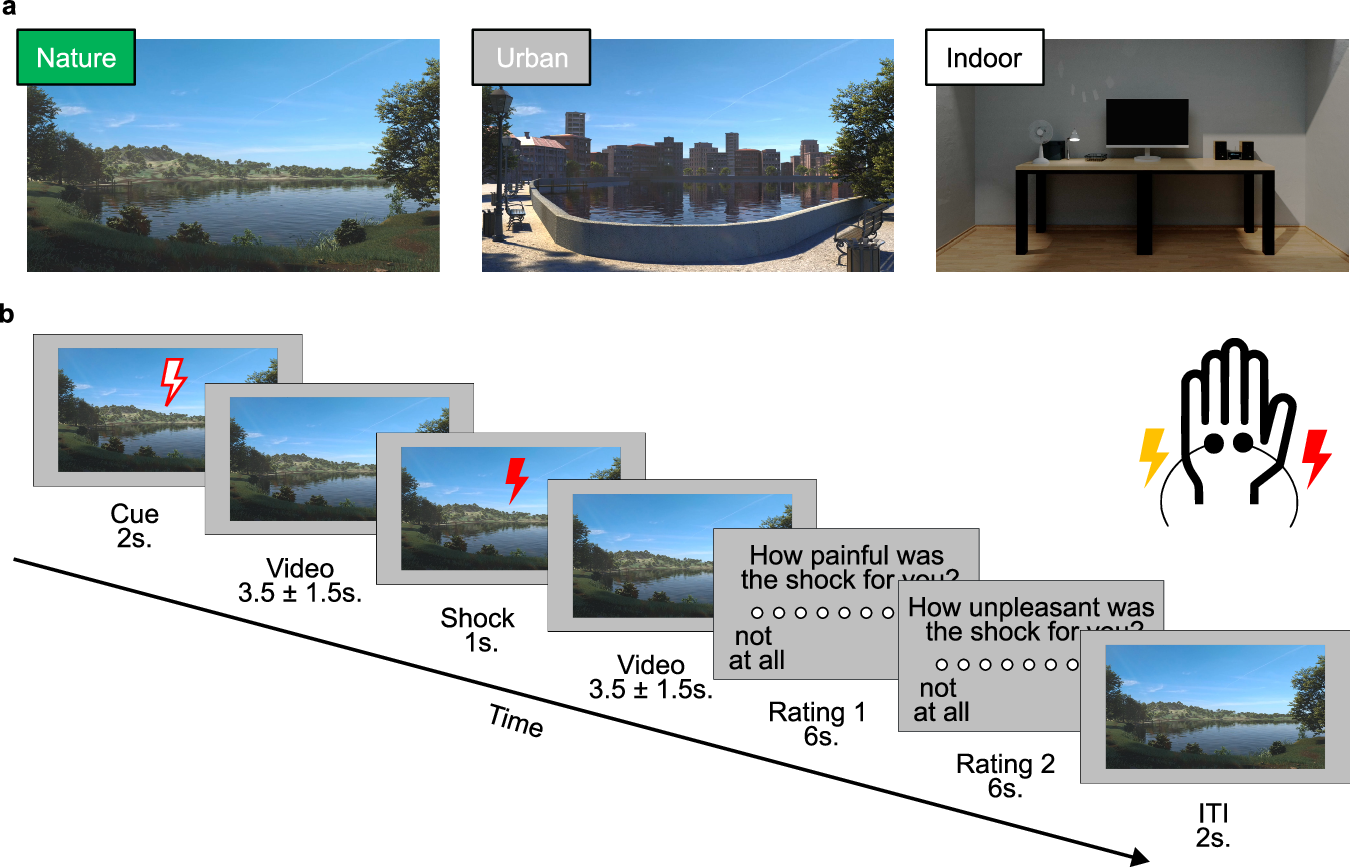
Nature exposure has numerous health benefits and might reduce self-reported acute pain. Given the multi-faceted and subjective quality of pain and methodological limitations of prior research, it is unclear whether the evidence indicates genuine analgesic effects or results from domain-general effects and subjective reporting biases. This preregistered neuroimaging study investigates how nature modulates nociception-related and domain-general brain responses to acute pain. Healthy participants (N = 49) receiving electrical shocks report lower pain when exposed to virtual nature compared to matched urban or indoor control settings. Multi-voxel signatures of pain-related brain activation patterns demonstrate that this subjective analgesic effect is associated with reductions in nociception-related rather than domain-general cognitive-emotional neural pain processing. Preregistered region-of-interest analyses corroborate these results, highlighting reduced activation of areas connected to somatosensory aspects of pain processing (thalamus, secondary somatosensory cortex, and posterior insula). These findings demonstrate that virtual nature exposure enables genuine analgesic effects through changes in nociceptive and somatosensory processing, advancing our understanding of how nature may be used to complement non-pharmacological pain treatment. That this analgesic effect can be achieved with easy-to-administer virtual nature exposure has important practical implications and opens novel avenues for research on the precise mechanisms by which nature impacts our mind and brain.