2025-07-15 熊本大学
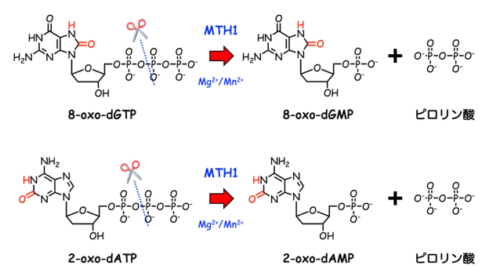
図 1 MTH1 による酸化ヌクレオチドの加水分解
<関連情報>
- https://www.kumamoto-u.ac.jp/whatsnew/seimei/20250715
- https://www.kumamoto-u.ac.jp/daigakujouhou/kouhou/pressrelease/2025_file/release20250715-2.pdf
- https://www.pnas.org/doi/10.1073/pnas.2510085122
ヒトNudix hydrolase MTH1の基質認識と触媒機構を中性子および時間分解X線結晶構造解析で解明 Neutron and time-resolved X-ray crystallography reveal the substrate recognition and catalytic mechanism of human Nudix hydrolase MTH1
Keisuke Hirata, Kana Fujimiya, Andreas Ostermann, +7 , and Teruya Nakamura
Proceedings of the National Academy of Sciences Published:July 17, 2025
DOI:https://doi.org/10.1073/pnas.2510085122
Significance
The protonation/deprotonation state at the enzyme active site is crucial for catalytic reactions. However, the protonation/deprotonation states of amino acid residues have rarely been experimentally demonstrated owing to the challenges in directly observing hydrogen atoms. The neutron structures of MTH1, an anticancer target, clearly show the protonation states of active-site residues that are crucial for broad substrate recognition by MTH1 and are important for designing MTH1 inhibitors. Furthermore, by combining neutron and time-resolved X-ray crystallography, we propose a reaction mechanism for MTH1 via three metal-binding sites, including the potential deprotonation pathway in catalysis, suggesting that the mechanism involving three metal-binding sites may be conserved among Nudix hydrolases.
Abstract
Human MTH1, a Nudix enzyme, hydrolyzes several oxidized nucleotides such as 8-oxo-dGTP and 2-oxo-dATP, owing to its broad substrate specificity. MTH1 has also attracted attention as an anticancer target, and its substrate recognition is of biological and medical interest. Previous studies have suggested that MTH1 exhibits broad substrate specificity by changing the protonation states of Asp119 and Asp120 with high pKa. However, the recognition mechanism remains unclear, owing to the difficulty in directly observing hydrogen atoms. Furthermore, a recent time-resolved X-ray study has proposed that Nudix hydrolases catalyze reactions through a new three-metal-ion mechanism. To understand the substrate recognition and catalytic mechanisms of human MTH1, we performed neutron and time-resolved X-ray crystallography. The neutron structures of MTH1 complexed with 8-oxo-dGTP and 2-oxo-dATP revealed the protonation states of the active-site residues, substrates, and water molecules, crucial for substrate binding and catalysis, providing direct experimental evidence that changes in the protonation states of Asp119 and Asp120 enable broad substrate recognition of MTH1. Time-resolved X-ray crystallography was used to visualize the entire reaction process through Mn2+ ion. The combination of neutron and time-resolved X-ray crystallography led to the proposal of a reaction mechanism for MTH1 via three metal-binding sites, including the conformational dynamics of a loop region, nucleophilic substitution, and a potential deprotonation pathway. Overall, the mechanism involving three metal-binding sites may be a general feature in the catalysis of Nudix hydrolases.