2025-07-28京都大学
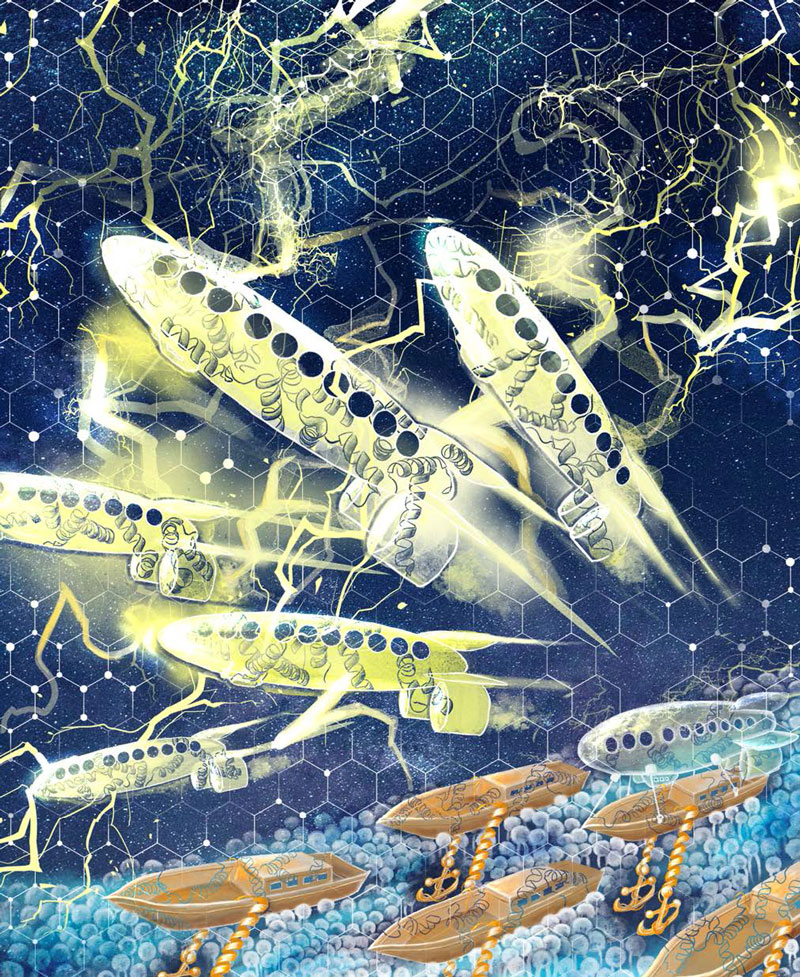
細胞膜から遊離した高活性FDH変異体によるDET型反応のイメージ(©京都大学生体機能化学研究室)
<関連情報>
- https://www.kyoto-u.ac.jp/ja/research-news/2025-07-28-4
- https://www.kyoto-u.ac.jp/sites/default/files/2025-07/web_2507_sowa-567fb1a87043217bf1ba7d1b65175cda.pdf
- https://pubs.acs.org/doi/10.1021/acselectrochem.5c00106
界面活性剤不含のヘテロトリマー型フルクトースデヒドロゲナーゼ変異体を用いたヘム1cおよびC末端親水性領域を欠失させた改良型直接バイオ電気化学的フルクトース酸化 Improved Direct Bioelectrochemical Fructose Oxidation with Surfactant-Free Heterotrimeric Fructose Dehydrogenase Variant Truncating Heme 1c and C-Terminal Hydrophobic Regions
Taiki Adachi,Konatsu Ichikawa,Tomoko Miyata,Fumiaki Makino,Hideaki Tanaka,Keiichi Namba,and Keisei Sowa
ACS Electrochemistry Published: July 11, 2025
DOI:https://doi.org/10.1021/acselectrochem.5c00106
Abstract
Direct electron transfer (DET)-type bioelectrocatalysis is a coupled redox reaction between enzymatic and electrode reactions. Such mediatorless reactions are an environmentally safe approach that can be applied to various bioelectrochemical devices. We focused on fructose dehydrogenase (FDH), a membrane-bound heterotrimeric enzyme that catalyzes DET-type d-fructose oxidation. Although the overall structure was recently elucidated, its membrane-bound region has not been completely identified. Therefore, this study assumed that the heme 1c region and C-terminal hydrophobic region (CHR) were bound to the membrane. A constructed double variant (Δ1cΔCHR_FDH) was soluble without any surfactants; additionally, cryo-electron microscopy confirmed that this variant was downsized. Δ1cΔCHR_FDH exhibited a 14-fold higher catalytic current density (11 ± 1 mA cm–2) than that of the wild-type recombinant FDH (rFDH) at multi-walled carbon nanotube electrodes. Kinetic analysis of the voltammograms suggested that downsizing of the enzyme and the removal of surfactants increased the surface concentration of enzymes at the electrode. This study will lead to efficient bioelectrocatalysis, overcoming the interference of surfactants.