2025-09-04 東京科学大学
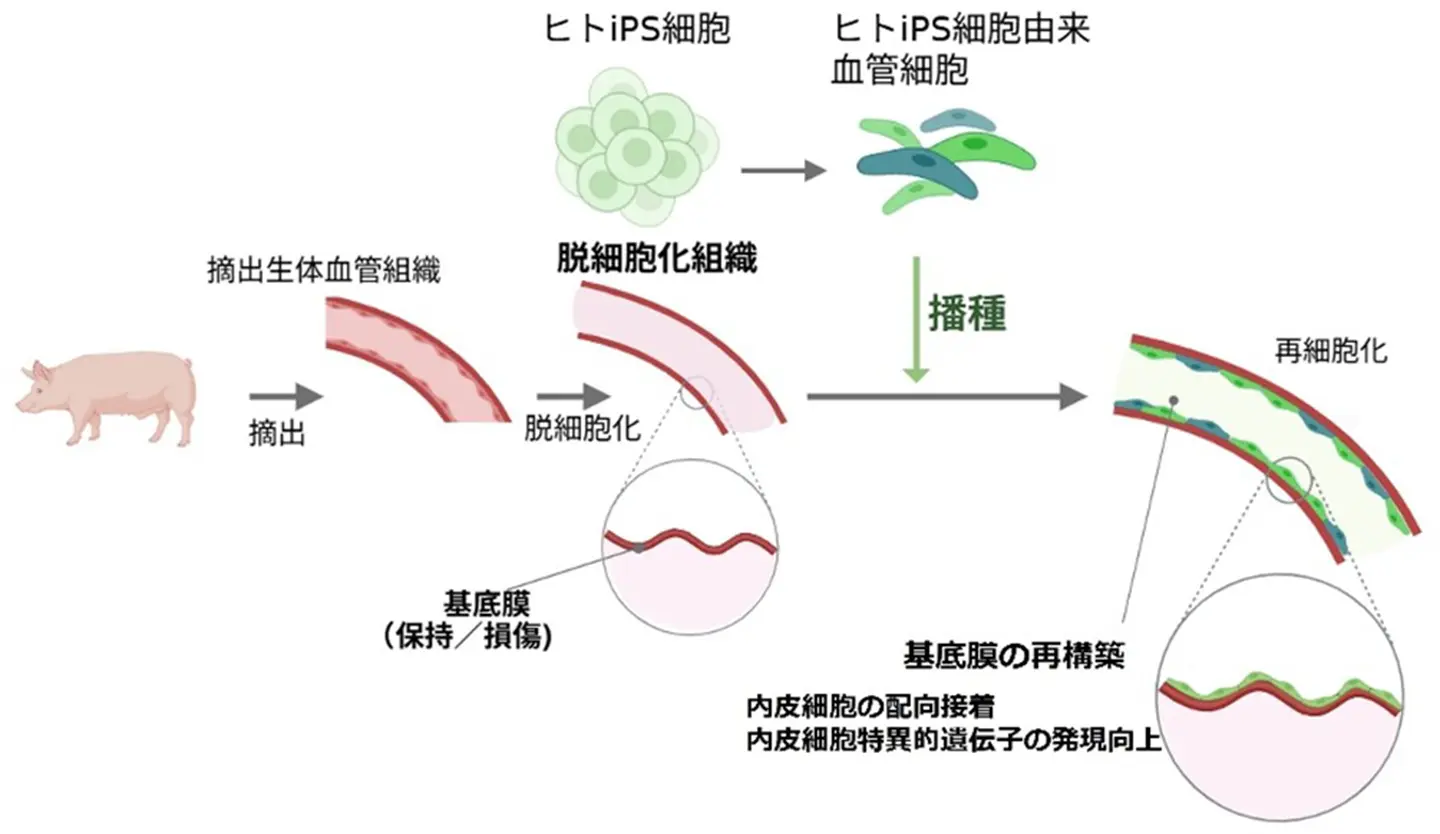
図1. 本研究成果の概要。ブタから取り出した血管組織を脱細胞化し、ヒトiPS細胞由来の血管内皮細胞を播種することにより、再生血管の構築を目指した。特に、脱細胞化後に残る基底膜の状態が、細胞の接着や機能に重要であることを示した。
<関連情報>
金属を含まない有機分子液体からの高速かつ効率的な常温蛍光 Recellularization of decellularized vascular grafts via aligned seeding of endothelial cells derived from human iPS cells
Mako Kobayashi,Kozue Murata,Masaya Yamamoto,Yoshihide Hashimoto,Tsuyoshi Kimura,Hidetoshi Masumoto & Akio Kishida
Scientific Reports Published:03 September 2025
DOI:https://doi.org/10.1038/s41598-025-07458-9
Abstract
The development of decellularized vascular tissues for tissue engineering and vascular implants presents a promising approach to creating functional blood vessels. However, effective endothelialization with human endothelial cells remains challenging. This study examined the endothelialization of decellularized porcine aortas using human induced pluripotent stem (hiPS) cell-derived endothelial cells. Various decellularization methods were used to create vessels with different luminal surface properties. hiPS-derived endothelial cells seeded on these vessels showed adhesion and alignment, particularly on those decellularized with the high hydrostatic pressure (HHP) method. These cells expressed higher levels of EphrinB2 compared to those cultured on flat surfaces, suggesting they respond to the vessel’s topographical features. The results indicate that hiPS-derived endothelial cells can adhere to and orient on decellularized porcine aortas, mimicking arterial endothelial behavior. For translational applications, achieving complete endothelial coverage by hiPSC-derived endothelial cells requires the establishment of optimal culture and seeding conditions. Nevertheless, these results highlight the importance of luminal surface topography and suggest that decellularized vascular tissues and implants can be designed with patterned surfaces to support endothelial behavior.