2025-09-25 長崎大学
<関連情報>
- https://www.nagasaki-u.ac.jp/ja/science/science414.html
- https://www.jbc.org/article/S0021-9258(25)02396-8/fulltext
ZFP36L1とL2はクリミア・コンゴ出血熱ウイルスの核タンパク質と相互作用し抗ウイルス因子として働く ZFP36L1 and L2 as novel antiviral factors for Crimean-Congo hemorrhagic fever virus via interaction with viral nucleoprotein
Minato Hirano ∙ Koki Nochi ∙ Momoko Matsugi ∙ … ∙ Jiro Yasuda ∙ Hirotaka Takahashi ∙ Kentaro Yoshii
Journal of Biological Chemistry Published:July 30, 2025
DOI:https://doi.org/10.1016/j.jbc.2025.110545
Abstract
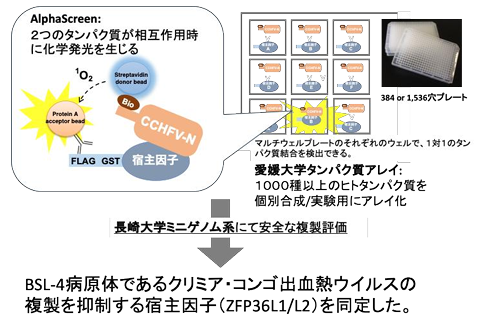
Crimean-Congo hemorrhagic fever virus (CCHFV) belongs to the genus Orthonairovirus and is the causative agent of viral hemorrhagic fever with a case fatality rate of 30%. Like many other viral proteins, the nucleoprotein (N) interacts with host factors during viral replication, leading to both pro- and anti-viral consequences. However, few studies have explored protein-protein interactions (PPI) between N and host proteins. In this study, we screened the PPI with 1116 human transcription factors and regulators using the AlphaScreen assay, which employs a cell-free synthesized human protein library. The host RNA-binding proteins, ZFP36L1 and L2, were identified through this screening, and further functional analyses revealed that both proteins significantly inhibited CCHFV minigenome replication. N and ZFP36 proteins interacted within cells, and the expression of N altered the intracellular localization of ZFP36 proteins. Interestingly, the RNA-binding activity of ZFP36s was not essential for the interaction and inhibition of CCHFV minigenome replication. A reporter assay using TNFA and IFNG UTRs, target RNAs of ZFP36 proteins, showed that CCHFV N activated ZFP36-mediated mRNA degradation. Further analysis revealed that the N-terminal region of ZFP36L1 was important for its interaction with CCHFV N. Deletion of the N-terminus of ZFP36L1 decreased its inhibitory effect on the minigenome, but not on the TNFA and IFNG reporters, suggesting context-dependent regulation of RNA degradation. This study demonstrated the applicability of PPI screening using protein array and AlphaScreen technology for investigating viral-host interactions. Further studies will contribute to understanding the antiviral immunity driven by host proteins and the corresponding viral countermeasures.