2025-09-25 中国科学院(CAS)
<関連情報>
- https://english.cas.cn/newsroom/research_news/life/202509/t20250922_1055150.shtml
- https://www.nature.com/articles/s41586-025-09572-0
哺乳類における多様な顎関節の収斂進化 Convergent evolution of diverse jaw joints in mammaliamorphs
Fangyuan Mao,Shan Jiang,Jun Liu,Jicheng Ren,Yong Ye,Yu Liu,Xin Shen,Tao Wang,Guofu Wang,Ping Wang,Juan Chen & Jin Meng
Nature Published:24 September 2025
DOI:https://doi.org/10.1038/s41586-025-09572-0
Abstract
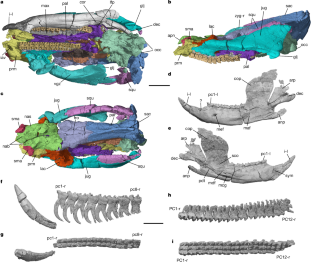
The evolution of a single-dentary-boned lower jaw and its secondary craniomandibular articulation between the dentary condyle and the squamosal glenoid has been regarded as a pivotal vertebrate innovation and defining mammalian trait1,2,3,4,5,6,7. Here we report two mammaliamorphs with novel shapes of secondary jaw joint, offering insight into the evolution of the mammalian jaw. The first, Polistodon8, a Middle Jurassic herbivorous tritylodontid with a relatively large body size and a lifestyle that is likely to have been fossorial, uniquely evolved a dentary–jugal articulation. The second, an Early Jurassic morganucodontan, exhibits a dentary–squamosal joint that lacks a bulbous condyle, supporting the hypothesis that the mammalian dentary condyle was formed by expansion of the lateral ridge of the dentary9. These diverse joints reflect repeated evolutionary experimentation in advanced cynodonts, in which secondary jaw joints arose independently7,10, and in which the load-bearing dentary–squamosal joint is a synapomorphy of mammaliaforms. Although body miniaturization might have driven this transformation11, our findings indicate that other factors were involved, such as jaw-muscle reorganization, feeding ecology and masticatory behaviour7,12,13,14,15,16,17. The ecomorphological diversity of these taxa suggest that phenotypic plasticity and environmentally induced morphological changes18,19,20 could have shaped jaw-joint evolution, emphasizing how ecological pressures and developmental flexibility guided the diversification of jaw structures in mammalian ancestors.