2025-10-16 シンガポール国立大学(NUS)
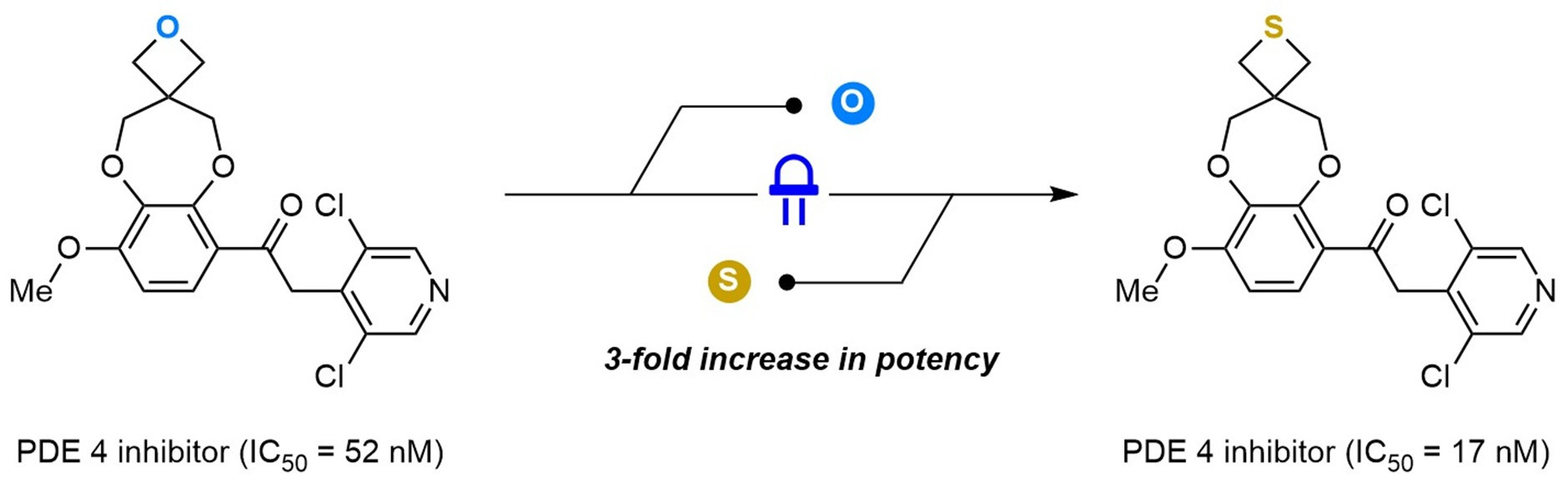
Direct editing of a bioactive oxetane using the oxygen-atom transmutation strategy provides rapid access to its sulfur analogue with improved potency. (Credit: Nature)
<関連情報>
- https://news.nus.edu.sg/atom-swapping-revolutionises-drug-synthesis/
- https://www.nature.com/articles/s41586-025-09723-3
オキセタンの光触媒酸素原子変換 Photocatalytic oxygen-atom transmutation of oxetanes
Ying-Qi Zhang,Shuo-Han Li,Xinglong Zhang & Ming Joo Koh
Nature Published:15 October 2025
DOI:https://doi.org/10.1038/s41586-025-09723-3
We are providing an unedited version of this manuscript to give early access to its findings. Before final publication, the manuscript will undergo further editing. Please note there may be errors present which affect the content, and all legal disclaimers apply.
Abstract
Non-aromatic heterocycles and carbocycles form the skeleton of countless bioactive and functional molecules1,2. Of note, four-membered saturated cyclic molecules such as azetidines, thietanes and cyclobutanes have garnered increasing attention in medicinal chemistry3-7. These molecules often possess physicochemical properties relevant to drug discovery: potency, stability, metabolic stability and target specificity3. The replacement of oxygen atoms in readily available oxetanes would offer a direct route to a variety of these cyclic pharmacophores, yet such atom swapping has been rarely reported for non-aromatic molecules. Here we report a general photocatalytic strategy that selectively substitutes the oxygen atom of an oxetane with a nitrogen-, sulfur- or carbon-based moiety, transforming it into a diverse range of saturated cyclic building blocks in a single operation. This atom swapping method exhibits high functional group compatibility and is applicable to late-stage functionalization, substantially simplifying the synthesis of pharmaceuticals and complex drug analogues that would otherwise require multi-step routes. Mechanistic investigations unveil insights on the origin of chemoselectivity that allows the endocyclic oxygen atom to react preferentially to generate an acyclic dihalide intermediate, which then undergoes efficient ring reconstruction in the presence of a nucleophilic species.