2025-10-15 甲南大学
<関連情報>
細胞間の機械的ストレスを伝達できるハイドロゲルによる生体内機械組織工学 In vivo mechano-tissue engineering by hydrogels capable of transmitting intercellular mechanical stress
Natsumi Ueda,Hayato Okazaki,Akihiro Mikuma,Ayane Kunieda,Soma Kawashima,Takeru Torii,Keiko Kawauchi,Masatake Matsuoka,Tomohiro Onodera,Norimasa Iwasaki & Koji Nagahama
Nature Communications Published:15 October 2025
DOI:https://doi.org/10.1038/s41467-025-64656-9
Abstract
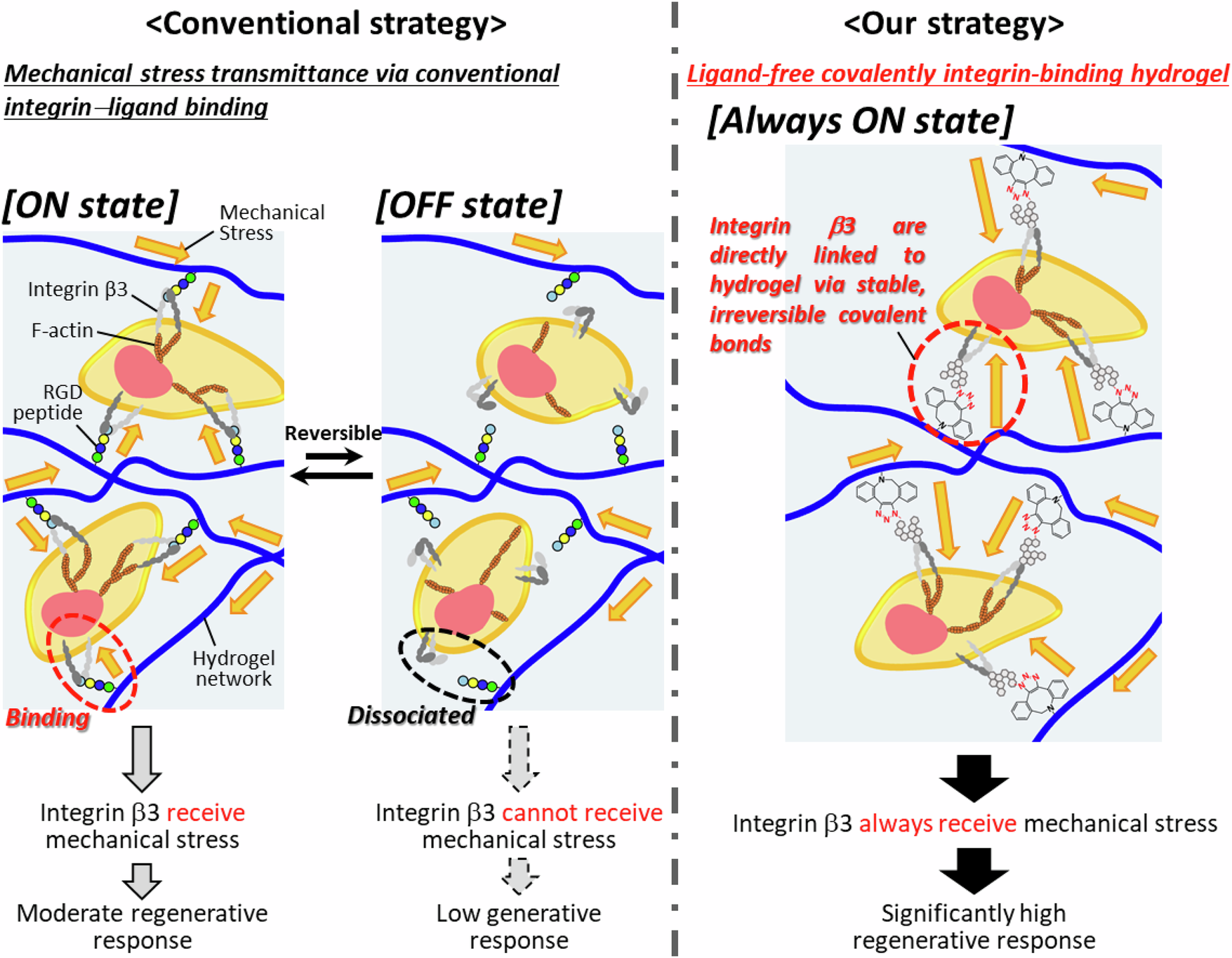
Integrating the latest insights from mechanobiology into tissue engineering could lead to innovative technologies. Here we show a method to effectively elicit the regenerative response of transplanted cells by utilizing mechanical stress generated in vivo. The essential feature of our method is that it does not use specific ligands for the vital mechanosensor integrins to mechanically activate them. In our method, azide groups are introduced into the integrin, and the hydrogel is modified with cyclooctyne (DBCO) groups. Thus, bioorthogonal click reaction between the azide groups and the DBCO groups forms direct, stable, irreversible covalent bonds between the cellular integrin and the hydrogel. We demonstrate that the integrin–hydrogel linkage is in ON state regardless of the intensity of the stress, the cell cycle, or the extracellular environment, so that mechanical stress is rapidly and reliably transmitted to the nucleus through the linkage in vivo, resulting in regenerative response of the transplanted cells.