2025-11-06 カロリンスカ研究所(KI)
Web要約 の発言:
<関連情報>
- https://news.ki.se/scientists-map-how-the-brain-develops-and-how-it-resolves-inflammation
- https://www.nature.com/articles/s41586-025-09663-y
脳の発達と神経炎症の空間ダイナミクス Spatial dynamics of brain development and neuroinflammation
Di Zhang,Leslie A. Rubio Rodríguez-Kirby,Yingxin Lin,Wenqi Wang,Mengyi Song,Li Wang,Lijun Wang,Shigeaki Kanatani,Tony Jimenez-Beristain,Yonglong Dang,Mei Zhong,Petra Kukanja,Shuozhen Bao,Shaohui Wang,Xinyi Lisa Chen,Fu Gao,Dejiang Wang,Hang Xu,Cong Ma,Xing Lou,Yang Liu,Jinmiao Chen,Nenad Sestan,Per Uhlén,… Rong Fan
Nature Published:05 November 2025
DOI:https://doi.org/10.1038/s41586-025-09663-y
Abstract
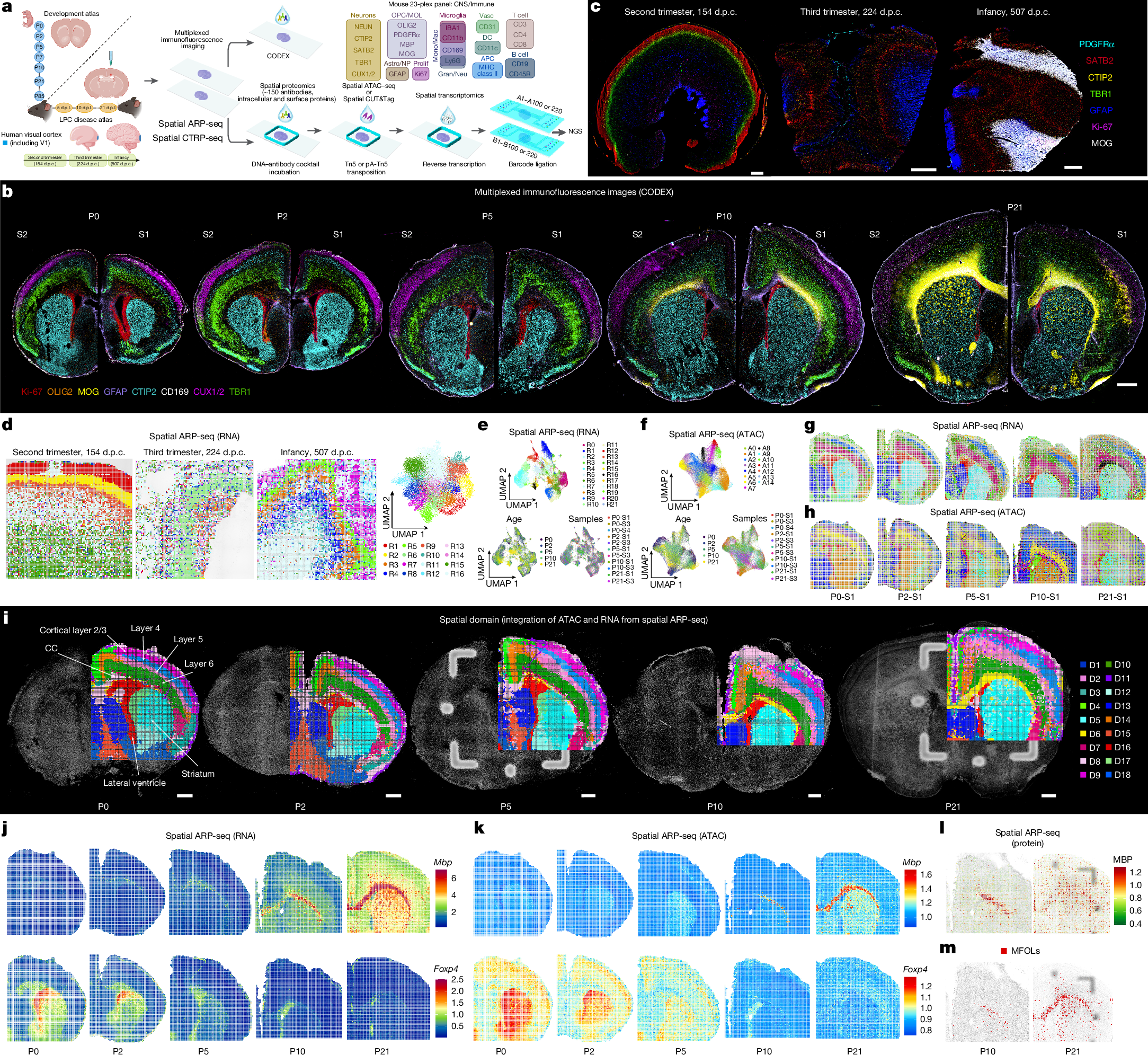
The ability to spatially map multiple layers of omics information across developmental timepoints enables exploration of the mechanisms driving brain development1, differentiation, arealization and disease-related alterations. Here we used spatial tri-omic sequencing, including spatial ATAC–RNA–protein sequencing and spatial CUT&Tag–RNA–protein sequencing, alongside multiplexed immunofluorescence imaging (co-detection by indexinng (CODEX)) to map dynamic spatial remodelling during brain development and neuroinflammation. We generated a spatiotemporal tri-omic atlas of the mouse brain from postnatal day 0 (P0) to P21 and compared corresponding regions with the human developing brain. In the cortex, we identified temporal persistence and spatial spreading of chromatin accessibility for a subset of layer-defining transcription factors. In the corpus callosum, we observed dynamic chromatin priming of myelin genes across subregions and identified a role for layer-specific projection neurons in coordinating axonogenesis and myelination. In a lysolecithin neuroinflammation mouse model, we detected molecular programs shared with developmental processes. Microglia exhibited both conserved and distinct programs for inflammation and resolution, with transient activation observed not only at the lesion core but also at distal locations. Overall, this study reveals common and differential mechanisms underlying brain development and neuroinflammation, providing a rich resource for investigating brain development, function and disease.