2025-11-18 東京科学大学
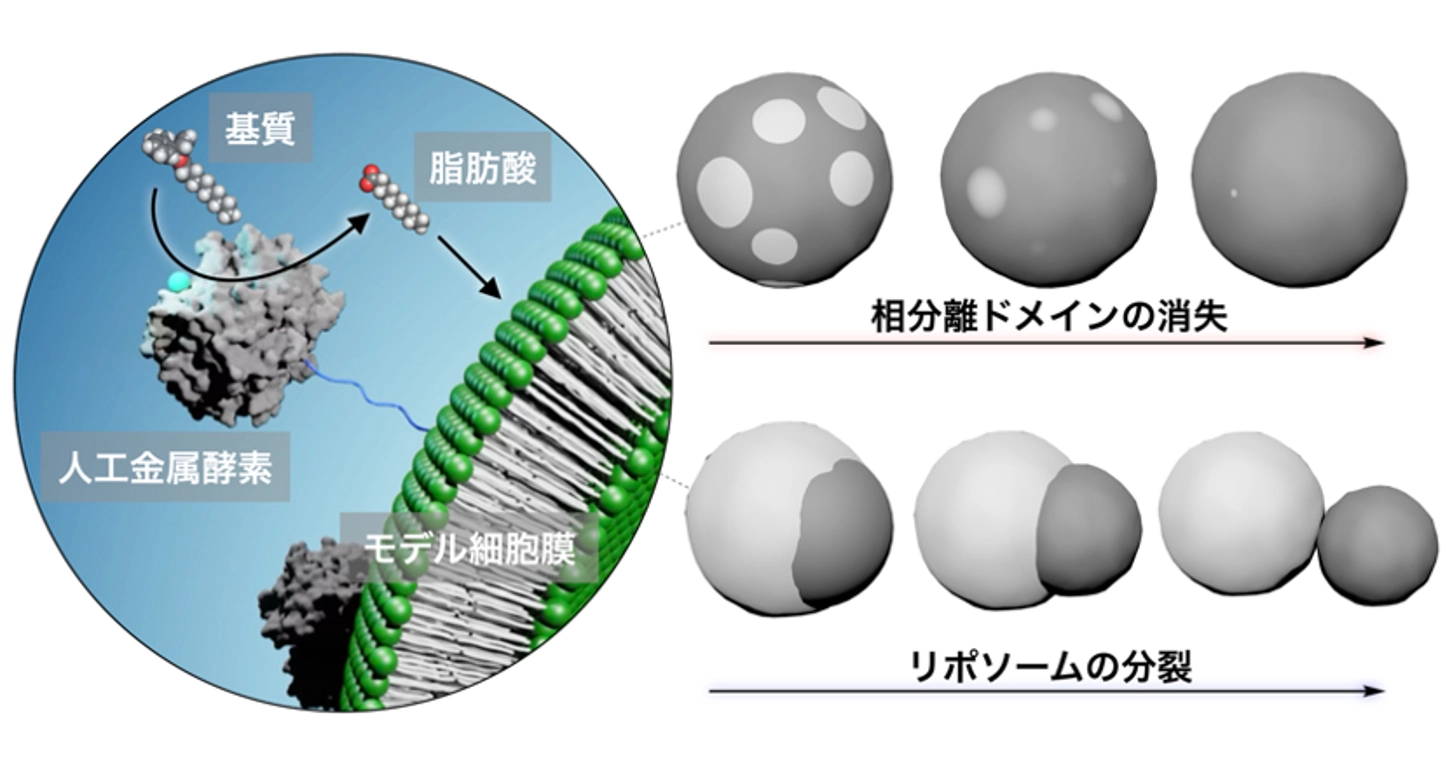
図1. 化学反応を利用したモデル細胞膜上の相分離ドメインの消失とリポソームの分裂
<関連情報>
閉環メタセシスによるプログラム可能な人工細胞膜ダイナミクス Programmable Artificial-Cellular Membrane Dynamics via Ring-Closing Metathesis
Rei Hamaguchi,Damian Alexander Graf,Kazushi Kinbara,and Thomas R. Ward
Journal of the American Chemical Society Published: October 15, 2025
DOI:https://doi.org/10.1021/jacs.5c10187
Abstract
Lateral phase-separated structures in cellular membranes serve as functional domains in various membrane-mediated biological processes. Controlling phase-separation dynamics through catalysis could enable the assembly of smart vesicles that exhibit life-like phenomena. Herein, we present the first example of dynamic control of lateral phase separation via a catalytic reaction: ring-closing olefin metathesis (RCM). This catalytic reaction occurs near the membrane by engineering the surface of lipid membranes with a biotin-streptavidin-based artificial metalloenzyme (ArM). We designed a substrate that, following RCM, releases decanoic acid, which could be spontaneously incorporated into the lipid bilayer, resulting in the disappearance of lipid domains within the membrane. Genetic optimization of the ArM led to a 3-fold increase in catalytic activity, ultimately leading to the budding of a larger lipid domain.