2026-01-23 名古屋大学
<関連情報>
- https://www.nagoya-u.ac.jp/researchinfo/result/2026/01/post-930.html
- https://www.nagoya-u.ac.jp/researchinfo/result/upload_images/20260123_sci.pdf
- https://journals.plos.org/plosmedicine/article?id=10.1371/journal.pmed.1004884
COVID-19パンデミック中の日本の高校生の心理的苦痛:エネルギーランドスケープ分析 Psychological distress among Japanese high school students during the COVID-19 pandemic: An energy landscape analysis
Daiki Tatematsu,Naotoshi Nakamura,Masato S. Abe,Tetsuo Ishikawa,Takahiro Ezaki,Lin Cai,Eiryo Kawakami,Kazuyuki Aihara,Atsushi Nishida,Naohiro Okada,Naoki Masuda,Kiyoto Kasai,Shinsuke Koike,Shingo Iwami
PLOS Medicine Published: January 22, 2026
DOI:https://doi.org/10.1371/journal.pmed.1004884
Abstract
Background
The stay-at-home orders, lockdowns, and states of emergency of the Coronavirus Infectious Disease emerged in 2019 (COVID-19) pandemic have affected the mental health of school-aged children. Previous reports of psychological distress in adolescents during the pandemic have been mixed, however, with some reports showing increases in psychological distress and others suggesting decreases. To accurately assess the impact of the pandemic, we need to be able to compare psychological assessments longitudinally, both before and during the pandemic. However, current statistical methods have limitations for reconstructing the complex trajectory of psychological states as captured by short-item questionnaires.
Methods and findings
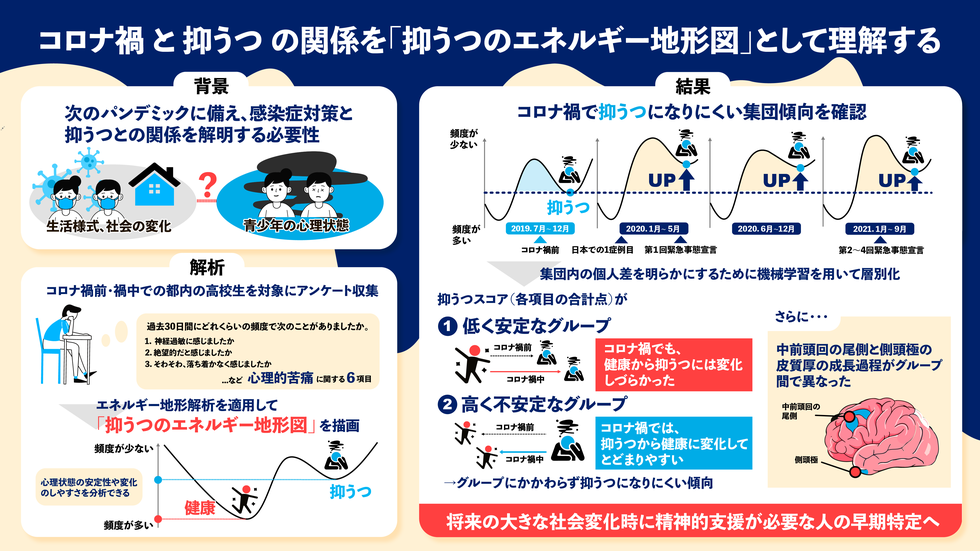
In this study, we analyzed monthly Kessler 6-item Psychological Distress Scale (K6) questionnaire responses collected from 16- to 18-year-old high school students participating in the population-neuroscience Tokyo TEEN Cohort (pn-TTC) in Japan (1,278 responses from 84 participants). Participants included 42 males and 42 females. The pn-TTC is a population-based longitudinal study conducted in Tokyo, Japan that follows children to investigate their developmental and mental health trajectories. In addition to conventional statistical approaches that summarize multiple questionnaire items into a composite score, we applied “energy landscape analysis,” a method derived from statistical physics that models multivariate psychological states as a dynamic system of interactions among K6 questionnaire items, to visualize longitudinal changes in psychological distress before and during the COVID-19 pandemic (July 2019 to September 2021). Here, we define the depressive and healthy states as configurations in which all six K6 items are above or below each participant’s individual mean, respectively. Before the pandemic, the healthy state occurred 11.0 times as frequently as the depressive state. In contrast, during the pandemic, the relative frequency of the healthy state increased to 18.2, 18.5, and 15.0 times that of the depressive state, respectively. The evolving energy landscape revealed an association between the pandemic period and a lower likelihood of being in a depressive state. We also identified two groups of students with different K6 dynamics and energy landscapes. The first group consisted of 61 participants whose total K6 score was relatively low (less than 5) and stable over time, and the second group consisted of 23 participants whose total K6 score was higher (with most being higher than 5) and less stable. The latter group showed a greater change in cortical thickness in the caudal part of the middle frontal gyrus (cMFG) (t-statistic = -2.36, p-value = 0.019, q-value = 0.048) and the temporal pole (TP) (t = 3.08, p = 0.0023, q = 0.012), as measured by magnetic resonance imaging, in the direction of accelerated adolescent brain development. Because all participants lived in Tokyo, generalizability remains limited, and as the association between psychological states and brain development is descriptive, future studies in diverse cohorts are needed to examine causality.
Conclusions
By revealing associations between the COVID-19 pandemic and lower levels of psychological distress and healthier mental health states, our work demonstrates the potential of using dynamical systems theory, such as the energy landscape analysis, to interpret health and disease metrics in psychology and psychiatry. This approach may improve mental health surveillance for the next pandemic.
Author summary
Why was this study done?
- The mental health of school-aged children has been affected by pandemic-related policies such as the stay-at-home orders, lockdowns, and states of emergency.
- Longitudinal comparisons of psychological assessments before and during the pandemic are essential to accurately evaluate its impact on adolescent mental health.
- Conventional statistical methods have limitations in capturing the complex dynamics of psychological states based on questionnaires, highlighting the need for new analytical approaches.
- Energy landscape analysis, a method derived from statistical physics, has the potential to capture the complex dynamics of psychological states.
What did the researchers do and find?
- We applied the energy landscape analysis to monthly Kessler 6-item Psychological Distress Scale (K6) questionnaire responses collected from July 2019 to September 2021, spanning both the pre-pandemic and pandemic periods.
- Analysis revealed that during the COVID-19 pandemic, adolescents were less likely to experience a depressive state and more likely to transition to a healthier psychological state.
- We identified two groups of students with different K6 dynamics and energy landscapes. The group whose total K6 score was higher and less stable showed greater brain developmental change in cortical thickness in the caudal part of the middle frontal gyrus (cMFG) and temporal pole (TP).
What do these findings mean?
- The COVID-19 pandemic was associated with a reduction in psychological distress and healthier mental health states among adolescents in this study.
- Dynamical systems approaches such as the energy landscape analysis may improve mental health monitoring during future pandemics.
- Main limitations include the fact that the participants in this cohort lived in Tokyo only, and the generalizability of our findings to adolescents living in other local areas and countries needs to be confirmed. Additionally, the association we found between psychological states and brain development remains descriptive, and further experimental or interventional studies are needed to validate causality.