2026-02-19 ワシントン大学セントルイス校
<関連情報>
- https://source.washu.edu/2026/02/blood-test-clocks-predict-when-alzheimers-symptoms-will-start/
- https://www.nature.com/articles/s41591-026-04206-y
血漿p-タウ217時計を用いた症状のあるアルツハイマー病の発症予測 Predicting onset of symptomatic Alzheimerʼs disease with plasma p-tau217 clocks
Kellen K. Petersen,Marta Milà-Alomà,Yan Li,Lianlian Du,Chengjie Xiong,Duygu Tosun,Benjamin Saef,Ziad S. Saad,Lei Du-Cuny,Janaky Coomaraswamy,Yulia Mordashova,Carrie E. Rubel,Emily A. Meyers,Leslie M. Shaw,Jeffrey L. Dage,Nicholas J. Ashton,Henrik Zetterberg,Kyle Ferber,Gallen Triana-Baltzer,Michael Baratta,Erin G. Rosenbaugh,Carlos Cruchaga,Eric McDade,David M. Holtzman,Alzheimer’s Disease Neuroimaging Initiative (ADNI) & On behalf of the Foundation for the National Institutes of Health (FNIH) Biomarkers Consortium Plasma Aβ and Phosphorylated Tau as Predictors of Amyloid and Tau Positivity in Alzheimer’s Disease Project Team
Nature Medicine Published:19 February 2026
DOI:https://doi.org/10.1038/s41591-026-04206-y
Abstract
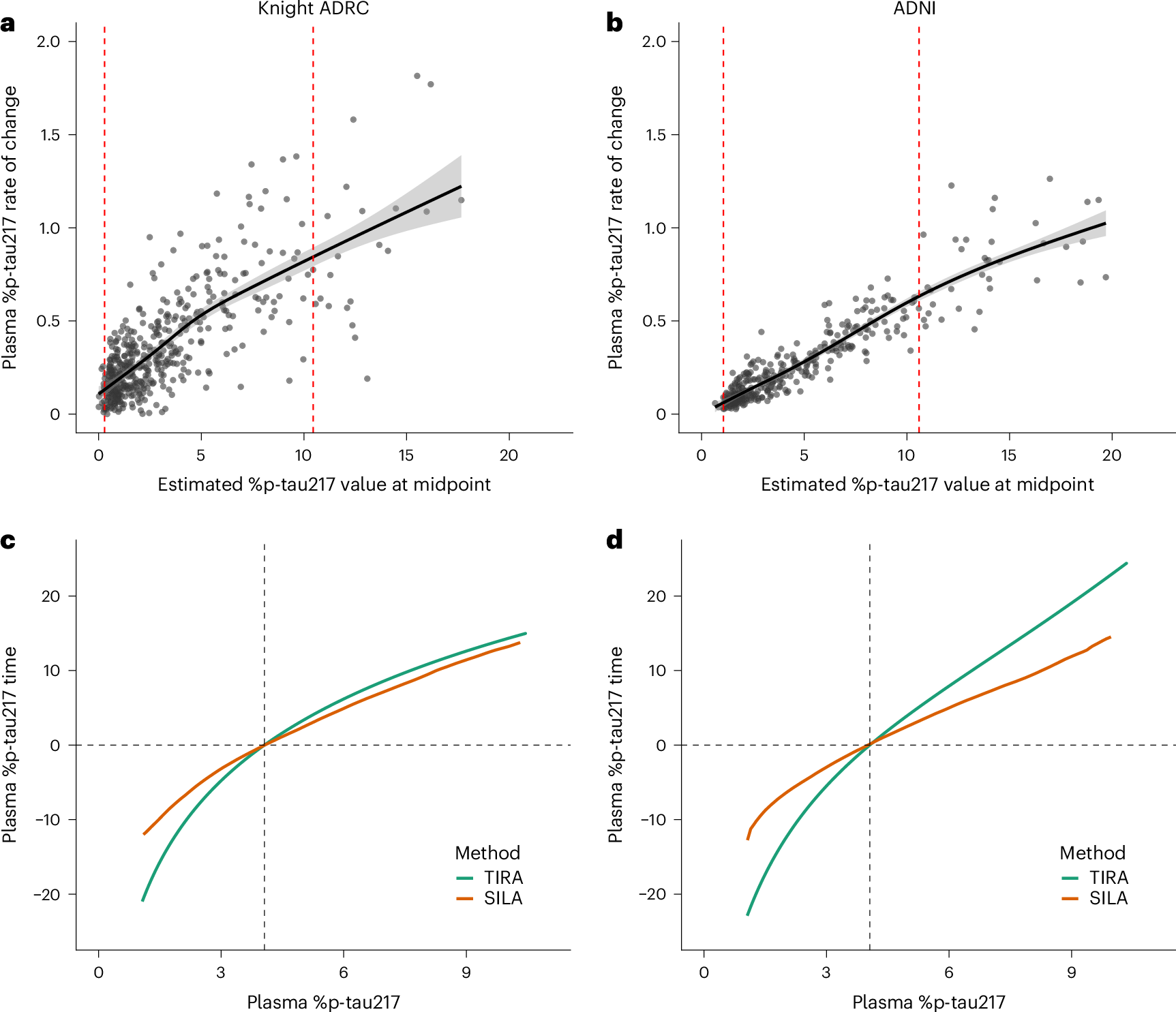
Predicting not just if, but also when, cognitively unimpaired individuals are likely to develop onset of Alzheimerʼs disease (AD) symptoms would be useful to clinical trials and, eventually, clinical practice. Although clock models based on amyloid and tau positron emission tomography have shown promise in predicting the onset of AD symptoms, a model based on plasma biomarkers would be more accessible. Using longitudinal plasma %p-tau217 (the ratio of phosphorylated to non-phosphorylated tau at position 217) from two independent cohorts (n = 258 and n = 345), clock models were used to estimate the age at plasma %p-tau217 positivity. The estimated age at plasma %p-tau217 positivity was associated with the age at onset of AD symptoms (adjusted R2 of 0.337-0.612) with a median absolute error of 3.0-3.7 years. Notably, the time from %p-tau217 positivity to onset of AD symptoms was markedly shorter in older individuals. Similar models were constructed with data from one p-tau217/Aβ42 immunoassay and four plasma p-tau217 immunoassays. These findings suggest that the time until onset of AD symptoms can be estimated using a single blood test within a margin of error that is acceptable for use in clinical trials.