2026-06-23 中国科学院(CAS)
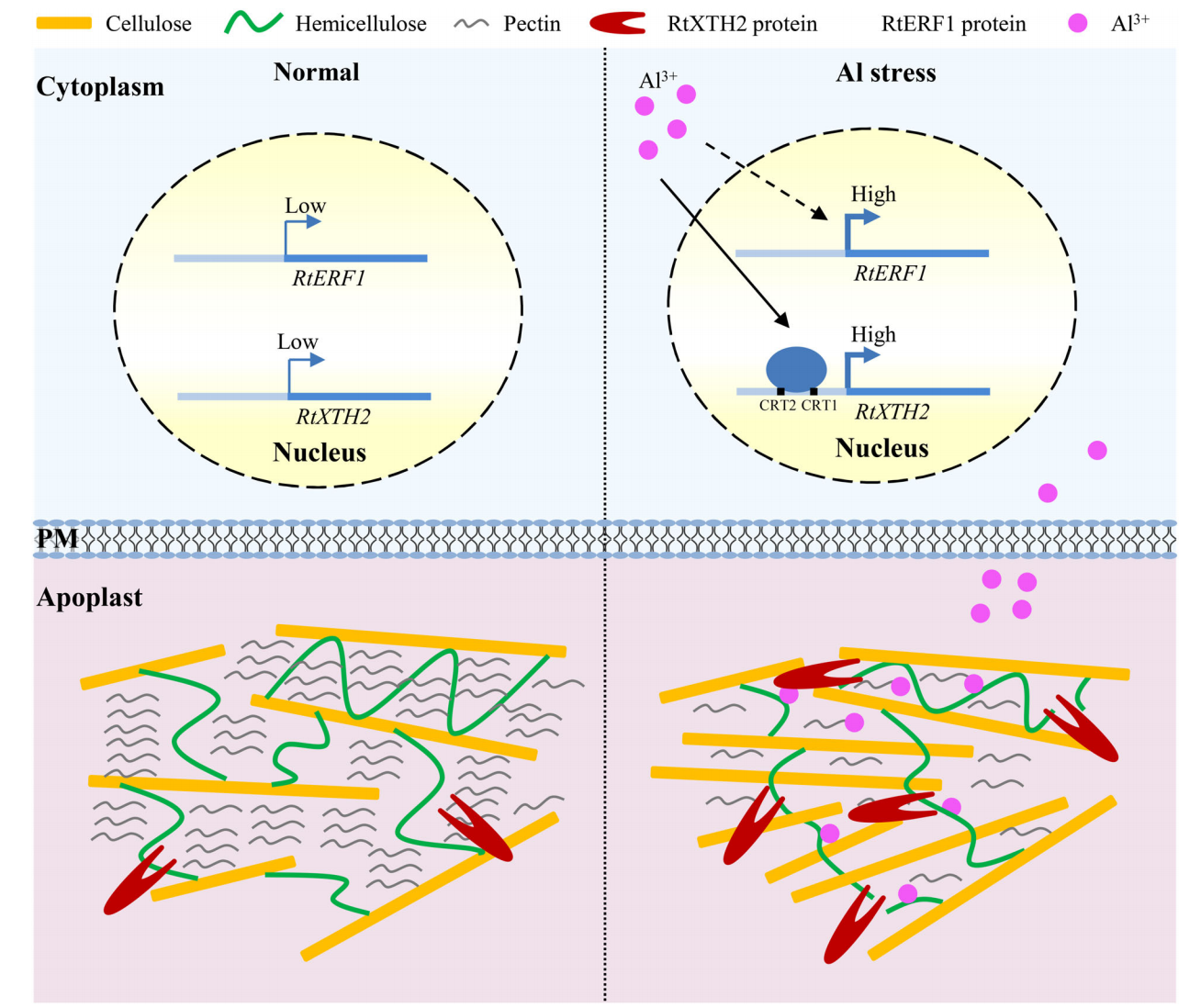
Proposed working model of the RtERF1–RtXTH2 regulatory module in response to Al stress in R. tomentosa. (Image by SCBG)
<関連情報>
- https://english.cas.cn/newsroom/research-news/202606/t20260626_1174912.shtml
- https://onlinelibrary.wiley.com/doi/10.1111/tpj.70988
RtERF1活性化RtXTH2は細胞壁成分の修飾を介してRhodomyrtus tomentosaのアルミニウム耐性を向上させる RtERF1-activated RtXTH2 enhances aluminum tolerance in Rhodomyrtus tomentosa via modifying cell wall components
Tingting Liu, Heng Yang, Ling Yang, Gui Wang, Sai Liu, Shulin Deng
The Plant Journal Published: 17 June 2026
DOI:https://doi.org/10.1111/tpj.70988
SUMMARY
Acidic soils trigger a surge of soluble aluminum (Al), thereby causing Al3+ toxicity that inhibits plant growth and limits crop yields. Rhodomyrtus tomentosa, a shrub distributed in tropical and subtropical regions with acid soil, is an important genetic source for exploring the mechanism of Al tolerance. The xyloglucan endotransglucosylase/hydrolase (XTH) cleaves and rejoins xyloglucan polymers, which is important for plants to adapt to Al3+ stress. In the present study, a total of 29 RtXTHs were identified in R. tomentosa. These RtXTHs showed distinct tissue-specific expression patterns. Al3+ stress significantly upregulated several RtXTH genes in the roots, among which RtXTH2 showed the most prominent responsiveness. The subcellular localization assay determined that RtXTH2 encoded a cell wall-localized XTH protein. Overexpression of RtXTH2 enhanced Al tolerance in Arabidopsis by reducing hemicellulose and pectin contents in the cell wall. RtERF1, an Al3+-induced AP2/ERF transcription factor, directly activated RtXTH2 by binding to the CRT elements in its promoter. Silencing either RtXTH2 or RtERF1 reduced Al tolerance in R. tomentosa seedlings, as evidenced by increased Al accumulation, enhanced membrane damage, and more severe inhibition of root elongation under Al3+ stress. In summary, our results indicate that RtERF1 activates RtXTH2 to modify cell wall composition, thereby enhancing Al tolerance in R. tomentosa.