2026-05-26 京都大学
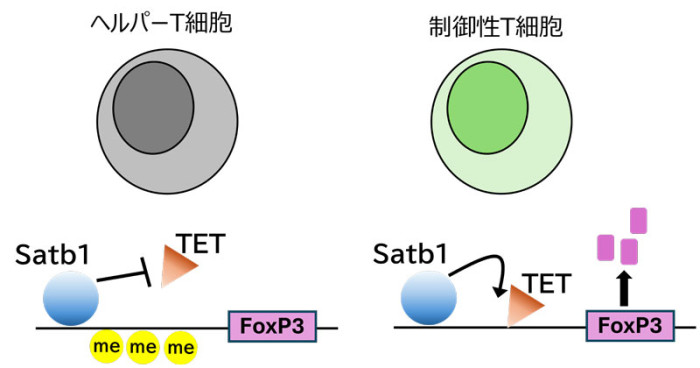
SATB1は、TET酵素(DNAメチル化のイレイサー)の働きを操ることで、FoxP3遺伝子のDNAのメチル化(me)を制御している。ヘルパーT細胞(左)においては、TET酵素の働きを抑制することで、DNAのメチル化状態を維持(FoxP3の発現がOFF)する。一方、制御性T細胞(Treg)(右)においては、TET酵素の働きを活性することで、DNAのメチル化状態を無くす(FoxP3の発現がON)。(図作成:SEO Wooseok))
<関連情報>
- https://www.kyoto-u.ac.jp/ja/research-news/2026-05-26-4
- https://www.sciencedirect.com/science/article/pii/S0006291X26007904?via%3Dihub
Satb1はDNAメチル化を介してFoxp3を抑制することにより、 CD4 +エフェクターT細胞系統の安定性を強化する Satb1 Enforces CD4+ Effector T Cell Lineage Stability by Repressing Foxp3 via DNA Methylation
Wooseok Seo, Chengcheng Zou, Krutula Nair, Haruhiko Koseki, Terumi Kohwi-Shigematsu, Hiroyoshi Nishikawa, Ichiro Taniuchi
Biochemical and Biophysical Research Communications Available online: 25 May 2026
DOI:https://doi.org/10.1016/j.bbrc.2026.154026
HIGHLIGHTs
- Satb1 loss in mature CD4+ T cells induces spontaneous Foxp3 expression.
- This aberrant Foxp3 derepression occurs independently of TGFβ signaling.
- Satb1 silences Foxp3 by maintaining TET-dependent DNA methylation.
- Satb1-deficient FoxP3+ cells are unstable.
ABSTRACT
Special AT-rich sequence binding protein 1 (Satb1) is a critical chromatin organizer that globally regulates the T lymphocyte transcriptome. While its influence on primary T cell development is well documented, defining its specific function in mature peripheral T cells has been complicated by the developmental defects inherent to early-stage deletion models. To bypass these limitations, we utilized a Thpok-cre conditional knockout system to delete Satb1 specifically within mature CD4 single-positive thymocytes. We demonstrate that the ablation of Satb1 results in the spontaneous emergence of an atypical CD25−FoxP3+ population from naïve peripheral CD4+ T cells. This aberrant de-repression of Foxp3 occurs independently of TGFβ signaling and is fundamentally driven by alterations in DNA methylation, requiring the activity of the TET2 and TET3 demethylases. Furthermore, we show that this Satb1-deficient Foxp3 expression is unstable during in vitro activation and is insufficient to confer full regulatory T cell (Treg) functionality. Collectively, our findings reveal a critical requirement for Satb1 in enforcing the lineage stability and functional fitness of conventional CD4+ T cells by maintaining the epigenetic silencing of Foxp3, providing vital insights into T cell homeostasis.