2026-06-26 中国科学院(CAS)
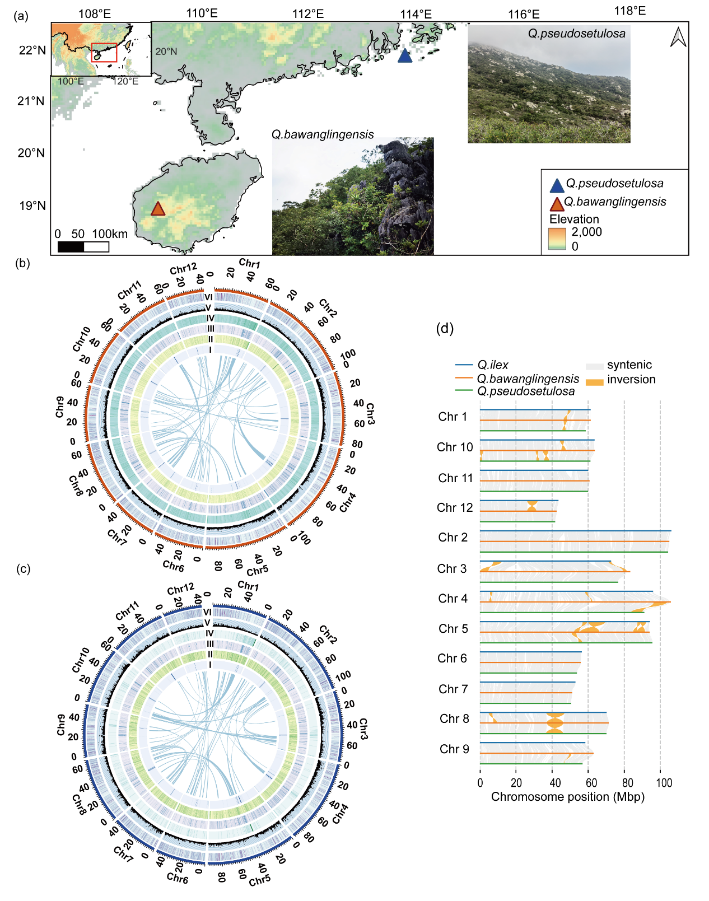
Geographic distribution, genomic characteristics, and genomic collinearity of Q. bawanglingensis and Q. pseudosetulosa. (Image by SCBG)
<関連情報>
- https://english.cas.cn/newsroom/research-news/202606/t20260626_1174913.shtml
- https://onlinelibrary.wiley.com/doi/10.1111/tpj.70953
人口動態史と自然選択体制が、絶滅危惧種の島嶼オーク2種における異なるゲノム構造を形成する Demographic history and natural selection regimes shape divergent genomic architectures in two endangered island oaks
Wenji Luo, Yi-Ye Liang, Qiong-Qiong Lin, Hui Liu, Shao-Jun Ling, Yong Shi, Biao-Feng Zhou, Zhao Shen, Jing-Shu Wang, Jing-Wei Niu, Liang-Jing Qiao, Wei-Shu Yan, Tieyao Tu, …
The Plant Journal Published: 28 May 2026
DOI:https://doi.org/10.1111/tpj.70953
SUMMARY
Genetic diversity is crucial for evolutionary resilience. Endangered species often suffer from reduced genetic diversity, elevated inbreeding, and accumulated genetic load due to population decline. However, some endangered species with small populations exhibit high genetic diversity and low inbreeding depression, indicating gaps in our understanding of evolutionary processes shaping genetic resilience. In this study, we conducted population genomic analyses on two endangered oaks, Quercus bawanglingensis and Quercus pseudosetulosa, endemic to fragmented limestone karsts, and assessed their demographic history, genomic diversity, genetic load, and signatures of selection. To provide high-quality genomic resources for evolutionary studies, we assembled chromosome-level genomes for these species and revealed high collinearity with other oak species, reflecting conserved genomic structure. Our findings showed that Q. pseudosetulosa displayed reduced genetic diversity due to a prolonged population decline, while Q. bawanglingensis maintained high diversity, attributed to a larger historical effective population size (Ne) along with its high outcrossing and longevity. Despite its small Ne, Q. pseudosetulosa exhibited minimal genetic load, suggesting efficient purging of deleterious mutations. Population genomic analyses revealed that the two species harbor different selected genes and exhibit distinct sweep dynamics, reflecting their unique genetic backgrounds and habitat distributions. Conservation strategies should consider genetic load, adaptive potential, and life-history traits, advocating for a more holistic approach to genetic resilience in small populations.