2026-06-26 名古屋大学
<関連情報>
- https://www.nagoya-u.ac.jp/researchinfo/result/2026/06/post-1022.html
- https://onlinelibrary.wiley.com/doi/10.1111/mec.70435
島嶼クワガタにおける性選択表現型の減少に伴う遺伝子流動の停止 Cessation of Gene Flow Associated With the Reduction of a Sexually Selected Phenotype in the Island Stag Beetle
Kodai Kishino, Yusuke Oikawa, Takeshi Wakamiya, Kunio Araya, Tadatsugu Hosoya, Naoto Idogawa, Masafumi Nozawa, Takehiro K. Katoh, Yasukazu Okada
Molecular Ecology Published: 25 June 2026
DOI:https://doi.org/10.1111/mec.70435
ABSTRACT
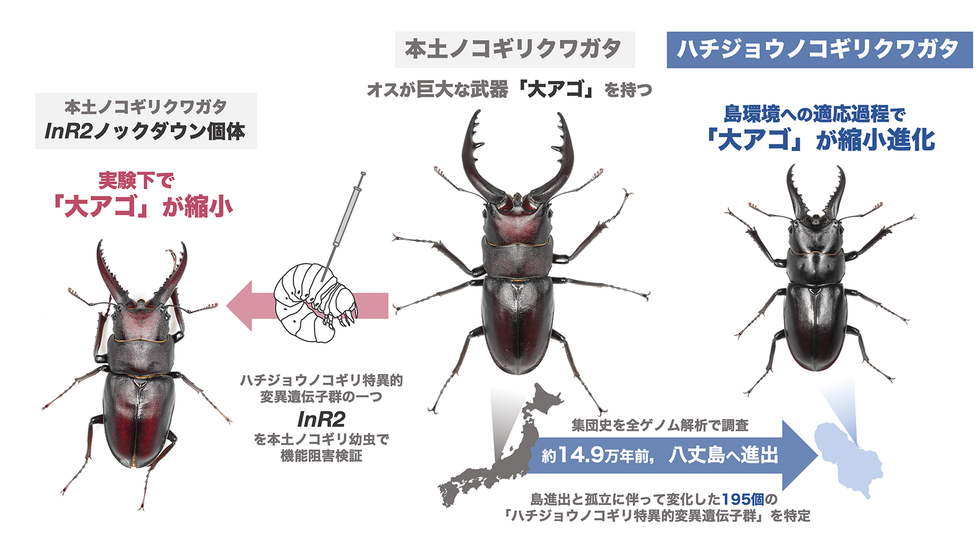
Whether gene flow acts as a creative or constraining force on local adaptation is a fundamental question in evolutionary biology, yet its role in the evolution of sexually selected traits remains poorly understood. Here we combine whole-genome and functional analyses to investigate how geological isolation is associated with the evolution of sexually selected traits. We focused on the stag beetle genus Prosopocoilus of the Izu Islands, Japan. In the mainland population (MLP), males possess sexually selected enlarged mandibles. In contrast, across the Izu Islands, relative mandible size decreases progressively with distance from the mainland, and this trend is most pronounced in the southernmost Hachijo-jima island population (HJP), which exhibits markedly dwarfed mandibles. Gene flow is estimated to have occurred from the MLP to the intermediate Izu island population (IIP), while the HJP remained isolated for approximately 149,000 years and evolved a distinct nuclear genetic composition. A genome-wide scan identified the insulin receptor gene InR2 as one of the HJP-specifically differentiated genes. The HJP’s InR2 region shows a signature consistent with positive selection. In contrast, in the IIP, where gene flow occurred, this same region was not differentiated. RNAi-mediated gene knockdown of InR2 in MLP males reduced male mandible size to resemble that of HJP males. Our results suggest geological isolation facilitates the evolution of genes associated with sexually selected traits, through reduced gene flow and subsequent local adaptation to the island’s specific nutritional resources.