2026-03-27 東海大学
<関連情報>
- https://www.tokai.ac.jp/news/detail/1001_notch.html
- https://www.nature.com/articles/s41467-026-70321-6
ノッチシグナル伝達を標的とした、ASDマウスモデルにおける神経発達と行動の回復 Targeting notch signaling to restore neural development and behavior in mouse models of ASD
Yoko Hanno,Moe Nakanishi,Akinori Takase,Jun Nomura,Masami Tanaka,Yumi Iida,Masayuki Tanaka,HiroyukiHosokawa,Masatoshi Ito,Katsunaka Mikami,Katsuto Hozumi,Goichi Miyoshi,Toru Takumi & Takatoshi Iijima
Nature Communications Published:30 March 2026
DOI:https://doi.org/10.1038/s41467-026-70321-6
Abstract
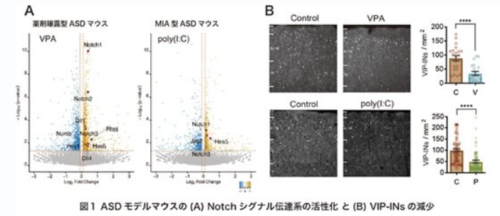
Autism spectrum disorder (ASD) is a neurodevelopmental disorder with diverse genetic and environmental origins, yet whether these factors converge on common molecular pathways remains unclear. This study identifies dysregulation of the Notch signaling pathway as a shared mechanism in both hereditary and nonhereditary ASD models. Aberrant histone deacetylase 3-mediated epigenetic regulation of Notch signaling during embryonic forebrain development disrupts the specification of vasoactive intestinal peptide (VIP + ) GABAergic interneuron subtypes (VIP-INs), which originate in the caudal ganglionic eminence (CGE). CGE-specific ablation of Notch1/2 genes in ASD models restores the loss of VIP-INs, normalizes maladaptive excitatory and inhibitory balance, and selectively improves social behaviors. A single antenatal dose of a γ-secretase inhibitor ameliorates multiple ASD-associated neuronal, behavioral, and transcriptomic changes in adult models. The study indicates a strong convergence of ASD-related factors on Notch signaling dysregulation and establishes this pathway as a promising therapeutic target for developmental and behavioral deficits in ASD.