2026-06-30 パシフィック・ノースウェスト国立研究所(PNNL)
<関連情報>
- https://www.pnnl.gov/publications/how-proteins-fine-tune-natures-iron-sulfur-electron-relays
- https://link.springer.com/article/10.1007/s00775-026-02151-2
[4Fe–4S]クラスターにおける酸化還元電位の幾何学的構造、スピン結合、および誘電率制御 Geometry, spin coupling, and dielectric control of redox potentials in [4Fe–4S] Clusters
Peter S. Rice,Bruno Jacob,Khushbu Agarwal,Marcel D. Baer & Simone Raugei
JBIC Journal of Biological Inorganic Chemistry
DOI:https://doi.org/10.1007/s00775-026-02151-2
Abstract
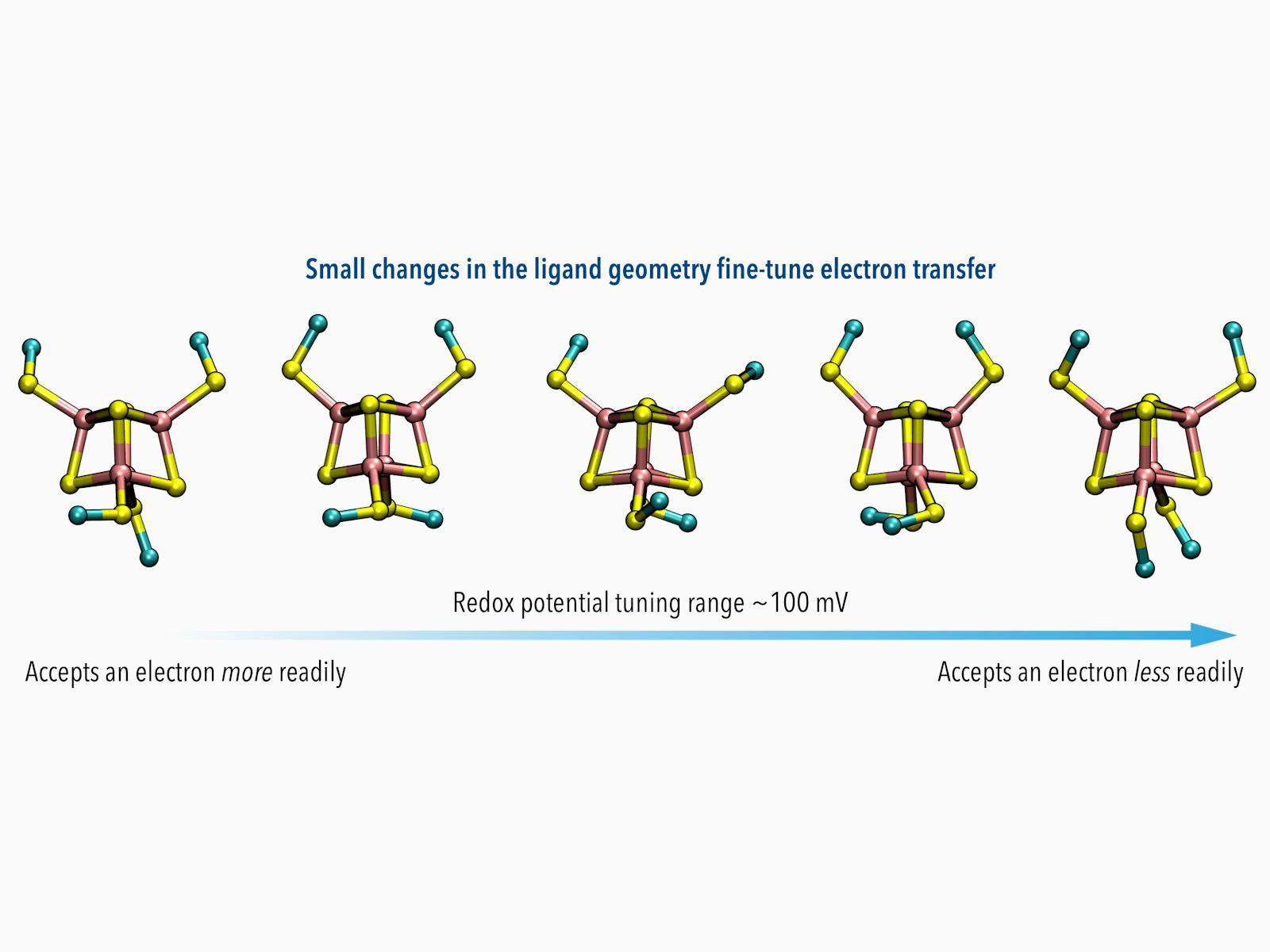
Iron–sulfur (Fe–S) clusters are common biological cofactors that facilitate vital redox reactions. Despite extensive research, the molecular basis of redox potential tuning in ferredoxin-like proteins remains an active area of debate. In this study, we combine statistical analysis of over one thousand [4Fe–4S]-containing protein structures from the Protein Data Bank (PDB) with broken-symmetry and extended broken-symmetry density functional theory to examine how cysteine ligand orientations and environmental screening affect redox properties of the clusters. We identified five main ligand configurations, three of which are predominant in natural structures. Among these, the adiabatic electron affinity differs by less than 0.1 V, indicating that, while geometry plays a secondary role, it allows localized fine-tuning of redox properties. In contrast, electrostatic and solvation effects primarily determine the overall potential range.