2026-04-01 中国科学院(CAS)
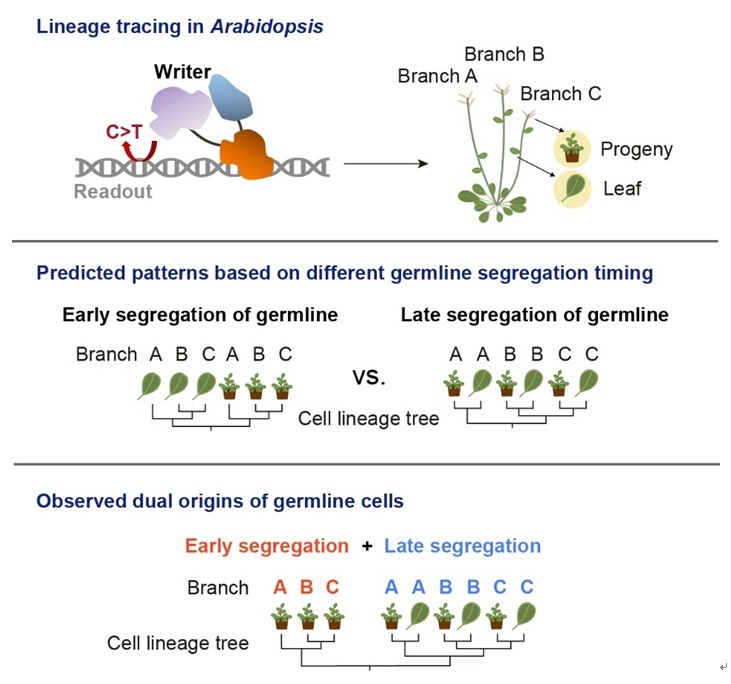
Lineage tracing in Arabidopsis reveals dual origins of germline cells. (Image by IGDB)
<関連情報>
- https://english.cas.cn/newsroom/research-news/202603/t20260327_1154069.shtml
- https://www.sciencedirect.com/science/article/abs/pii/S0960982226002587
シロイヌナズナにおけるワイスマンの遺伝資源説の検証 Testing Weismann’s germ plasm theory in Arabidopsis
Haotian Guo, Geyu Zhang, Lu Gao, Yang Liu, Yu Wang, Zhan Liu, Chunmei Guan, Chun Zhang, Li Liu, Qing Huan, Wenfeng Qian
Current Biology Available online: 30 March 2026
DOI:https://doi.org/10.1016/j.cub.2026.03.003
Highlights
- Dynamic editing-based lineage tracing is applied to Arabidopsis
- Some progenies from different plant branches cluster in the cell lineage tree
- Green progenies can arise from albino siliques in the Atmsh1 mutant
- Late-arising mutations are infrequently detected in progeny
Summary
Weismann’s germ plasm theory proposed that germline cells are set aside early in development, ensuring that mutations arising in somatic tissues during an organism’s lifetime are not inherited. While this principle has been well supported in animals, it has not been rigorously tested in plants. Plants differ fundamentally from animals in that their meristematic cells drive continuous growth and organ formation throughout life, leading to the long-held view that the plant germline segregates late. Here, we used a dynamic genome-editing lineage tracing system to construct cell lineages in Arabidopsis thaliana, including both somatic and germline cells. Our analysis of the cell lineage tree revealed two distinct germline segregation patterns. While some germline cells clustered with somatic cells from their branch of origin (consistent with late segregation), others from different branches shared a recent common ancestry (indicative of early segregation). This supports a dual-origin model for germline cells in A. thaliana: early-segregated germlines represent a plant counterpart to Weismann’s barrier, reducing the risk of transmitting excessive mutations across generations, whereas late-segregated germlines can inherit beneficial mutations acquired during development, potentially facilitating adaptation.