2026-04-02 ノースカロライナ州立大学(NCState))
<関連情報>
- https://news.ncsu.edu/2026/04/sensors-lower-cost-of-genetic-disorder-research/
- https://www.nature.com/articles/s44328-026-00088-9
カーボンナノチューブマイクロ電極アレイにより、脳オルガノイドの拡張性とアクセス性に優れた電気生理学的記録が可能になる Carbon nanotube microelectrode arrays enable scalable and accessible electrophysiological recordings of cerebral organoids
Navya Mishra,Rajaram Kaveti,Pei Liu,Baha Erim Uzunoglu,Aram Mirabedini,Anna Tran,Z. Begum Yagci,Tyler Johnson,Parvez Ahmmed,Qiuli Wang,Jeong Yong Kim,Paris Brown,Surjendu Maity,Shyni Varghese,Michael D. Dickey,Yong Zhu,Alper Bozkurt,Raudel Avila,Albert J. Keung & Amay J. Bandodkar
npj Biosensing Published:01 April 2026
DOI:https://doi.org/10.1038/s44328-026-00088-9
Abstract
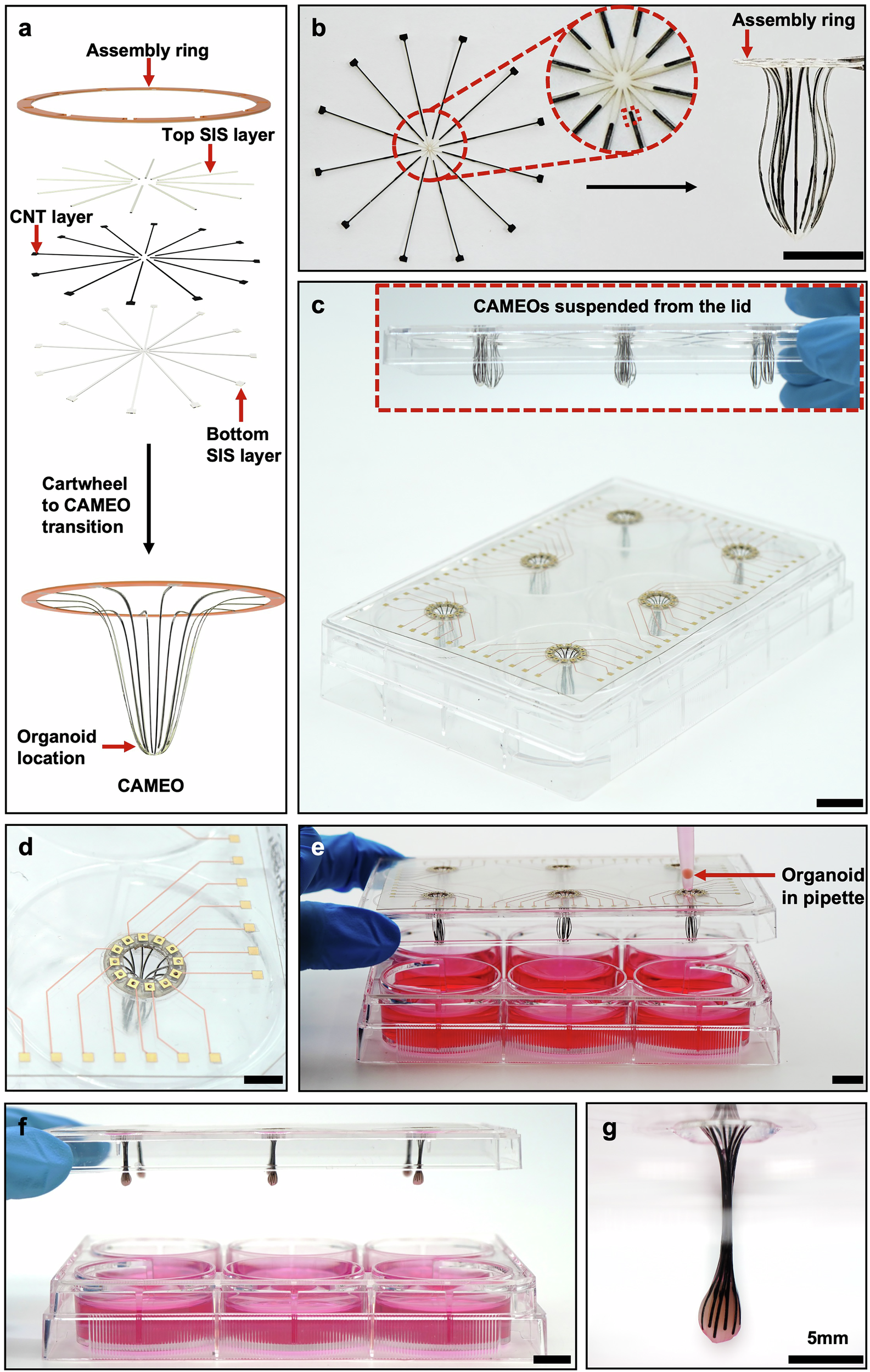
Human cerebral organoids hold promise for studying neurodevelopment, modelling disease, and drug screening. Electrophysiology is a key functional property for these studies; yet, performing high-throughput electrophysiological studies with organoids remains a critical bottleneck. Current state-of-the-art recording technologies, including 2D and 3D microelectrode arrays (MEAs), are low-throughput, expensive to fabricate and purchase, and often incompatible with routine organoid culture. These limitations restrict their adoption, and many studies report electrophysiological activity from insufficient sample sizes to accurately capture the widely accepted biological variability inherent to organoid models. Here, we present a scalable, low-cost, plug-and-play platform that integrates a new class of carbon nanotube-based 3D microelectrode arrays into standard cell culture plates. This system enables high-throughput extracellular recordings from many organoids without specialised workflows. Using this system, we record electrophysiological signals from 74 human cortical organoids, the largest scale reported in organoid electrophysiology studies to the best of our knowledge. The measurements involve capturing electrophysiological phenotypes across neurotypical and Angelman Syndrome organoids. We also show that the use of carbon nanotubes in place of conventional gold electrodes achieves superior electrical, electrochemical, and electromechanical properties at a fraction of the cost while enabling a new scalable manufacturing technique. This technology establishes a standardised and accessible route to large-scale electrophysiological measurements in organoids.